

Quick Answer
Outsourced staffing solutions let companies fill specialized roles, such as AI, cybersecurity, and digital transformation positions, without opening a foreign entity. Nearshoring places talent in a nearby, time zone-aligned country for close, real-time collaboration. Offshoring taps larger, lower-cost talent pools in more distant markets for scale. Most organizations now combine both approaches, matching the model to the skill, budget, and speed each role requires.
Key Takeaways
- Shortages in AI, cybersecurity, and digital transformation talent are pushing organizations to search beyond domestic labor markets.
- Global workforce strategy is becoming a competitive necessity, giving businesses access to skills that are scarce or unavailable locally.
- Nearshoring prioritizes collaboration and proximity; offshoring prioritizes scale and access to larger talent pools.
- The right choice depends on communication needs, skill specialization, hiring speed, cost, and compliance requirements.
- Hybrid workforce models that blend nearshore and offshore talent are becoming the default approach.
- Successful global hiring requires expertise in labor regulations, compensation benchmarks, and local market dynamics, not just sourcing.
- Companies with a deliberate, long-term global talent strategy are better positioned to close skills gaps and accelerate growth.
Why the Global Talent Gap Is Pushing Companies Across Borders
AI expertise is now the hardest skill set to source anywhere in the world. ManpowerGroup’s 2026 Talent Shortage Survey found that 72% of employers across 41 countries report hiring challenges for AI-related roles, alongside persistent gaps in cybersecurity and digital transformation. This isn’t a short-term imbalance. It reflects a structural shift in workforce demand that is prompting companies to look beyond traditional local hiring.
Businesses are responding by going global, and increasingly doing it strategically through nearshoring, offshoring, or a deliberate blend of both, accessed through outsourced staffing. The global outsourcing market reached approximately $854.6 billion in 2025 and is projected to hit $1.11 trillion by 2030, underscoring how central this approach has become to how organizations scale, innovate, and compete.
The scale of the shortage is stark. Korn Ferry’s Global Talent Crunch study projects a global talent shortage of more than 85 million people by 2030, which could translate into $8.5 trillion in unrealized annual revenue if left unaddressed.
Technology and cybersecurity feel this gap most acutely. The 2025 ISC2 Cybersecurity Workforce Study estimates a global shortfall of 4.8 million cybersecurity practitioners, and the World Economic Forum suggests the cybersecurity workforce would need to expand by nearly 90% to meet today’s security requirements. In practical terms, that gap shows up as delayed product launches, unpatched vulnerabilities, and digital transformation projects stalled at the pilot stage.
International hiring is already the response. Multiplier’s Global Teams Report 2026 found that 46% of companies are turning to international hiring to secure AI skills unavailable in their local markets. Remote work made this shift practical: managing teams across time zones, once considered logistically complex, is now the default for many organizations. Outsourced staffing built around distributed teams gives businesses a practical entry point into global talent, without setting up foreign entities or navigating unfamiliar labor laws alone.
What’s the Difference Between Nearshoring and Offshoring?
Nearshoring means working with talent in a geographically close country that shares or closely overlaps your time zone. For U.S. companies, that typically means Latin America; for European businesses, Central and Eastern Europe. The advantage is collaboration: real-time standups, quick pivots, and cultural alignment without a wide time-zone gap.
Offshoring moves operations to more distant markets, including India, the Philippines, and Vietnam, where labor cost advantages are larger and talent pools run deeper for high-volume roles. The trade-off is coordination overhead: asynchronous communication, cultural calibration, and disciplined, well-documented workflows.
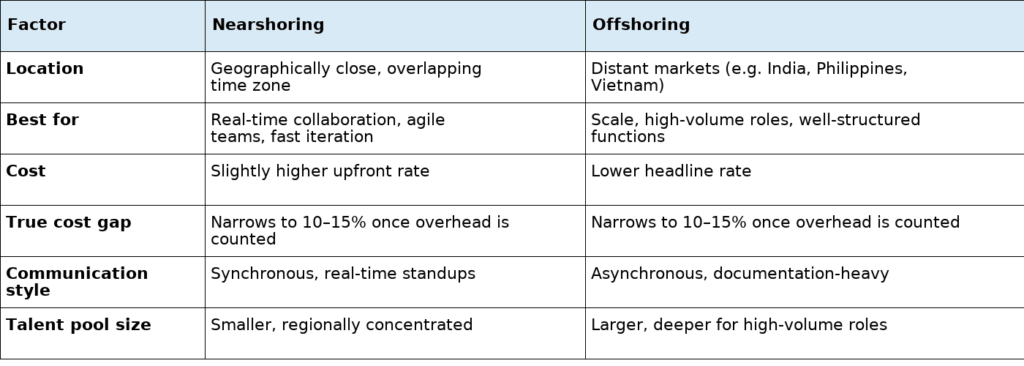
Nearshoring is currently the fastest-growing outsourcing model. It is growing at a CAGR of 13.95% between 2026 and 2031, driven by demand for collaboration, time-zone alignment, and cultural compatibility on complex, mission-critical IT work. Remote nearshore hiring has grown approximately 285% since 2016.
The cost gap between the two models is smaller than it appears on paper. McKinsey research shows that once management overhead, communication inefficiency, and quality assurance are factored in, the actual total engagement cost difference between nearshore and offshore solutions typically narrows to just 10-15%. Cost alone rarely justifies the choice; fit does.
When Should You Choose Nearshoring vs. Offshoring?
There’s no universal answer, and any outsourced staffing partner worth working with will say so.
Nearshoring works best when collaboration intensity is high: agile software development, DevOps, cybersecurity response, or digital transformation work where daily communication isn’t optional. It tends to show a higher success rate on projects that require frequent iteration.
Offshoring works best when building teams at scale for well-structured functions: IT support, data processing, back-office operations, or customer service. The Philippines has a thriving IT-BPM sector with 1.82 million workers and roughly $38 billion in annual revenue, while India continues to lead large-scale enterprise tech delivery. Both offer deep talent pools and mature delivery ecosystems that are genuinely hard to beat on economics for the right type of work.
The hybrid approach is gaining ground fastest: placing strategic or client-facing roles in nearby markets while running execution-heavy functions through established offshore hubs.
How to Choose the Right Outsourced Staffing Model for 2026
The framing has shifted. As John Clements noted in its 2026 outsourcing trends analysis, access to skilled talent, not cost reduction, has become the primary driver behind outsourcing decisions. The old model trimmed budgets. The new model accesses capabilities that simply don’t exist in the local labor market.
The World Economic Forum’s Future of Jobs Report 2025 found that 63% of employers see skill gaps in the labor market as a major barrier to business transformation, which puts global talent access in a different strategic category altogether.
Four questions should drive the decision:
- How collaborative is the work? High-iteration, communication-intensive roles favor nearshoring. Defined, process-driven functions favor offshoring.
- How specialized is the skill? Niche AI and cybersecurity expertise may require tapping larger offshore talent pools if local supply doesn’t exist.
- What’s the priority, cost or speed? Offshore markets save more; nearshore markets move faster and onboard more smoothly.
- What’s your compliance risk tolerance? Nearshoring can reduce regulatory complexity in regulated industries, especially where data sovereignty or proximity to oversight matters.
What to Look for in an Outsourced Staffing Partner
Choosing the right outsourcing arrangement is harder than most first-time organizations expect. Research from Deloitte found that more than a third of companies that launched outsourcing initiatives without a clear strategy switched providers within a year, incurring significant transition costs. Successful outsourcing depends as much on planning and alignment as it does on picking the right provider.
A capable outsourced staffing partner brings more than a list of CVs. In addition, look for knowledge of local compensation benchmarks, labor law compliance, regional market nuances, and a pre-vetted talent pipeline. This helps shorten time-to-productivity for new hires. Furthermore, they should offer flexible engagement models, such as staff augmentation, project-based teams, or long-term embedded talent. As a result, the structure adapts to the work rather than the other way around.
Ultimately, the difference between a vendor that places people and a true outsourced staffing partner comes down to one thing. Specifically, it depends on whether they integrate into your delivery model. Alternatively, they may simply provide a list of candidates and step away.
The Future of Talent Is Configurable
Over the next five years, success in attracting and retaining talent will depend less on company size or hiring budget. Rather, it will depend on how effectively organizations plan their global workforce. To achieve this, the strongest performers will know when to use nearshore resources. Likewise, they will understand when offshore talent makes more sense. Most importantly, they will know how to combine both models to support business goals while maintaining operational efficiency and scalability.
Meanwhile, the global talent gap is real. In fact, the shortage of specialized skills is accelerating. As a result, the outsourcing market is scaling to address both challenges. Consequently, organizations need strategic clarity to choose the right model. Equally important, they need a staffing partner with the regional expertise to execute it effectively. Ultimately, organizations that align their workforce strategy with the right sourcing model will be better positioned to achieve long-term growth and competitive advantage.
Frequently Asked Questions
What is outsourced staffing?
Outsourced staffing is a workforce model where a business partners with a staffing provider to source, hire, and manage talent, often in other countries, instead of building that capability in-house. It covers nearshoring, offshoring, and hybrid arrangements, and typically includes compliance, payroll, and workforce management support.
What’s the difference between nearshoring and offshoring?
Nearshoring places talent in a nearby country that shares or closely overlaps your time zone, prioritizing real-time collaboration. Offshoring places talent in more distant markets with larger, lower-cost talent pools, prioritizing scale for well-structured, high-volume roles.
Is nearshoring more expensive than offshoring?
On paper, nearshoring often carries a higher headline rate. In practice, McKinsey research shows the total cost gap, once management overhead, communication inefficiency, and quality assurance are included, typically narrows to just 10-15%.
Which industries benefit most from offshoring?
IT support, data processing, back-office operations, and customer service tend to benefit most from offshoring, since these functions are well-structured and scale efficiently. The Philippines and India are among the largest offshore hubs for these roles.
How do I decide between nearshoring, offshoring, or a hybrid model?
Base the decision on four factors. Consider how collaborative the work is. Assess how specialized the skill is. Determine whether cost or speed matters more. Also consider your compliance risk tolerance.
Many organizations land on a hybrid model, keeping client-facing or strategic roles nearshore and running execution-heavy functions offshore.
Unlock Global Talent Without Borders
The competition for specialized talent is no longer limited by geography. Whether a company is exploring nearshoring, offshoring, or a hybrid workforce model, the right strategy makes critical skills easier to reach and faster to deploy. John Clements provides outsourced staffing solutions that connect businesses with qualified talent worldwide while handling compliance, scalability, and workforce planning. Here’s how a global talent strategy can support your growth goals.
Learn more at https://johnclements.com/client-solutions/outsourcing/.

