
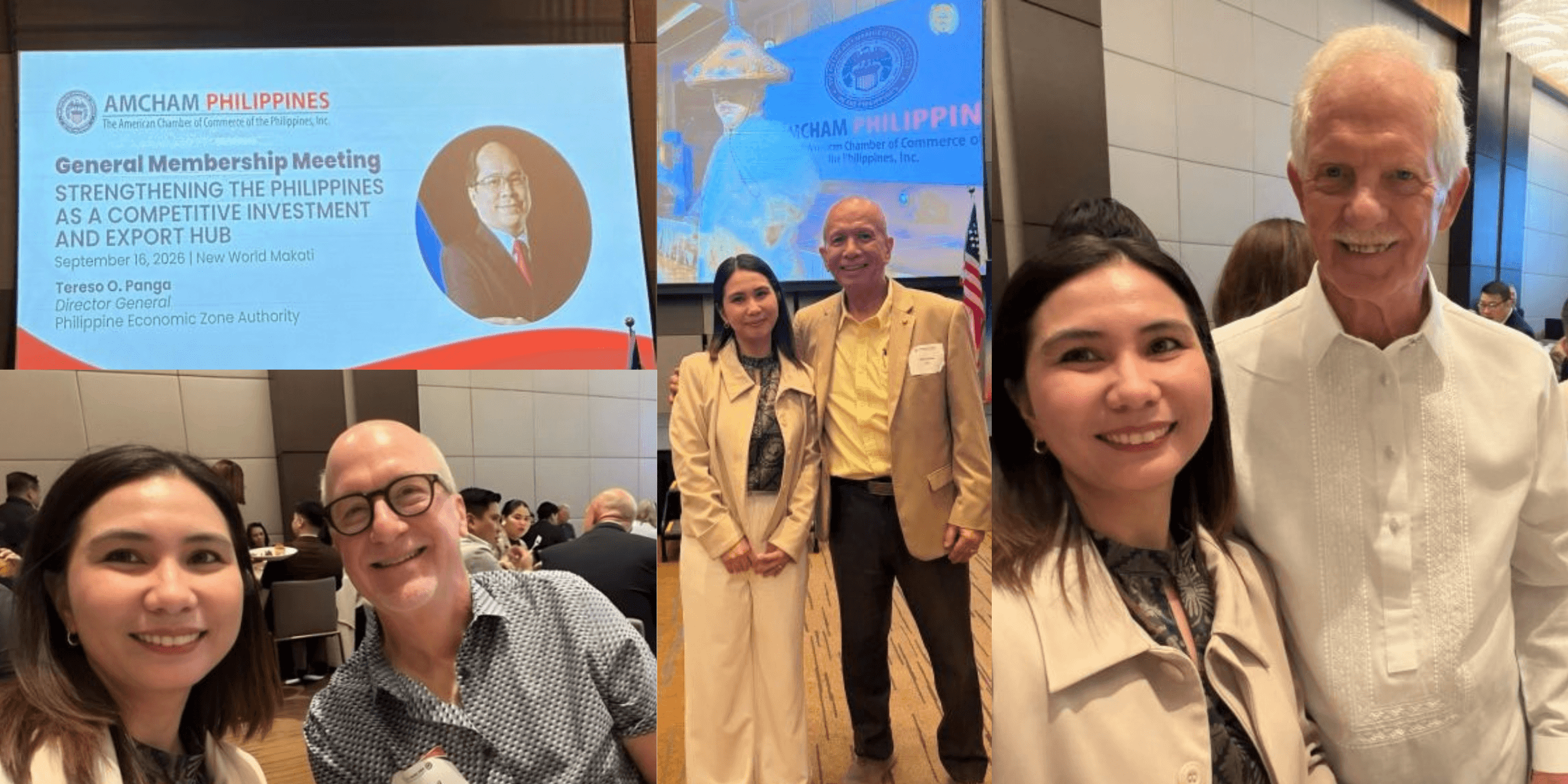
I was privileged to attend the AmCham Philippines General Membership Meeting at New World Makati where I gained valuable insights from the presentation, “Strengthening the Philippines as a Competitive Investment and Export Hub,” delivered by Director General Tereso Panga of the Philippine Economic Zone Authority (PEZA).
It was a meaningful opportunity to learn more about the country’s investment and export landscape and the initiatives designed to strengthen the Philippines investment hub for global businesses.

How Ecozoning Is Reshaping Economic Development
The Philippines is strengthening its position as an investment destination by looking beyond traditional economic-zone incentives. The direction presented by PEZA is clear: economic zones must evolve into integrated ecosystems that help investors establish, operate, and expand while creating opportunities for Filipino workers, local suppliers, and host communities.
This approach, often described as ecozoning, connects investment attraction with industrial development, infrastructure, technology, talent, digital government services, and sustainability. Rather than serving solely as locations for factories or offices, ecozones are becoming platforms where businesses can access the practical conditions needed for long-term success.
Furthermore, this strategy supports the country’s goal of developing a stronger and more sustainable Philippines investment hub.
For more information about PEZA, visit:
From Incentives to Complete Operating Ecosystems
Global investors now make decisions in a more complex business environment. Supply chains continue to evolve, companies seek greater resilience, and organizations increasingly diversify operations across multiple countries.
Cost remains important. However, it is no longer the only consideration.
Investors also evaluate:
- Reliable power and water supply
- Efficient transportation and port access
- Skilled talent availability
- Digital connectivity
- Regulatory transparency
- Strong supplier networks
- Long-term expansion capacity
Consequently, the Philippines has an opportunity to compete not only project by project but ecosystem by ecosystem. The goal is to help investors move smoothly from project approval to operational readiness, export activity, and future expansion.
A manufacturing company needs more than industrial land. It also needs utilities, logistics support, regulatory facilitation, skilled workers, and market access. Effective economic zones bring these elements together and reduce barriers to growth.
The Luzon Economic Corridor as a Growth Engine
One of the most significant initiatives highlighted by PEZA is the Luzon Economic Corridor (LEC), which links Subic Bay, Clark, Metro Manila, and Batangas.
The corridor strengthens connectivity among major business, industrial, aviation, logistics, and port centers. As a result, companies can locate different functions in areas that best match operational requirements.
For example:
- Metro Manila supports corporate and shared services operations.
- Batangas offers strong manufacturing capabilities.
- Clark supports aviation, warehousing, and technical activities.
- Subic and Batangas provide strategic logistics and port access.
According to PEZA’s presentation, the LEC had:
- 218 operating PEZA ecozones
- 1,777 PEZA-registered enterprises
As of July 2026, Metro Manila accounted for 190 ecozones and 1,146 enterprises, while Batangas hosted 18 ecozones and 536 enterprises. Pampanga recorded 9 ecozones and 89 enterprises, while Zambales had 1 ecozone and 6 enterprises.
These figures demonstrate the strong foundation of the Philippines investment hub and its ability to support future expansion.
A Strong Foundation of U.S. Investment
The Philippines continues to attract and retain major American investors. According to PEZA, 249 registered U.S. enterprises have generated cumulative investments of PHP 413.09 billion, or approximately US$6.58 billion.
These enterprises generated:
- US$10.488 billion in exports in 2025
- 382,559 cumulative jobs
Importantly, these investments span multiple industries, including:
- Semiconductors
- Electronics
- IT-BPM
- Software development
- Engineering
- Aerospace
- Finance
- Logistics
Companies highlighted by PEZA included Texas Instruments, Amkor, Google, Amazon, IBM, Teradyne, Western Digital, Cognizant, Wells Fargo, Visa, TaskUs, Foundever, Carelon, and Alorica.
Their continued presence strengthens investor confidence and demonstrates that the Philippine market can support both advanced manufacturing and knowledge-based services.
PAX Silica and the Semiconductor Opportunity
The Philippines joined the U.S.-led PAX Silica initiative in April 2026, signaling its intention to strengthen participation in secure and resilient semiconductor supply chains.
Specifically, PEZA referenced a proposed 1,620-hectare PAX Silica Ecozone within the Luzon Economic Corridor. The project aims to support manufacturing and investment activities tied to semiconductor and technology supply chains.
The country already possesses a well-established electronics and semiconductor sector. Therefore, the next step involves attracting complementary services such as:
- Advanced assembly and testing
- Precision tooling
- Equipment maintenance
- Automation support
- Quality assurance services
- Engineering support
- Specialized logistics
This opportunity reinforces the country’s position as a growing Philippines investment hub serving high-value industries.
Ecozones Supporting Countryside Development
Ecozoning also promotes inclusive economic growth.
PEZA reported 441 operating ecozones nationwide as of July 2026, including:
- 250 IT Centers
- 85 Manufacturing Ecozones
- 62 IT Parks
- 24 Agro-Industrial Parks
- 17 Tourism Ecozones
- 3 Medical Tourism Zones
- 1 KIST Park
- 1 Pharma Park
The wider distribution of ecozones enables provinces and emerging cities to develop according to their unique strengths. In turn, these investments can create jobs closer to communities, support local suppliers, and reduce development pressures on Metro Manila.
Moreover, PEZA identified several emerging ecozone concepts, including:
- Aerotropolis parks
- Agro-forestry ecozones
- Biotech centers
- Defense industrial complexes
- Fintech hubs
- Renewable-energy parks
- Pharmaceutical ecozones
- Integrated townships
An agro-industrial ecozone illustrates this concept clearly. Beyond agricultural production, such zones can support food processing, packaging, laboratory testing, logistics, warehousing, and export services.
Preparing Talent for Future Industries
Investment growth depends on talent.
PEZA’s workforce initiatives recognize that future industries require highly specialized skills. The PEZA AI Tech Academy in Cebu, implemented with StackTrek and accredited by TESDA, provides training in artificial intelligence, blockchain, fintech, and related technologies.
According to the presentation, the academy completed 16,000 AI certifications since its launch in January 2026.
Meanwhile, the Mold Technology Support Center in Clark focuses on:
- CNC machining
- Precision tooling
- Mold design
- Die production
The center has trained more than 3,000 workers since 2023.
PEZA additionally promotes Knowledge, Innovation, Science and Technology (KIST) Parks that connect academia, research institutions, and industry partners. These initiatives help ensure a stronger future workforce for the Philippines investment hub.
Digitalization and Sustainability as Business Enablers
Modern economic zones must help businesses operate efficiently and responsibly.
PEZA’s digitalization initiatives include:
- The One Portal System
- Electronic import permits
- E-PEZA visa services
- E-building permits
- E-payment systems
- The Ecozone Transfer System
Consequently, businesses can reduce paperwork, improve transparency, and accelerate routine transactions.
Sustainability also remains a key priority. PEZA has promoted:
- Eco-industrial park certification
- Water safety initiatives
- Microgrid solar projects
- Wastewater treatment systems
- Geothermal solutions
- Solar energy projects
For investors, sustainability improves operational resilience while supporting evolving global standards and supply-chain requirements.
Additional information is available at:
Turning Investment Momentum Into Long-Term Impact
PEZA’s recent figures indicate continued investor confidence.
From January to August 2026, PEZA approved:
- 196 projects
- PHP 216.47 billion in investments
The presentation also reported:
- US$32.89 billion in exports from January to June 2026
- 1.826 million jobs supported
For American-linked projects during the same period, PEZA reported:
- PHP 2.71 billion in investments
- 15 approved projects
- US$209.71 million in projected exports
- 4,353 projected jobs
These numbers are encouraging. However, approval alone does not guarantee success. The real measure lies in operational execution, sustainable employment, workforce development, supplier growth, and long-term expansion.
What This Means for John Clements and Workforce Partners
For us at John Clements, ecozoning and investment growth create an opportunity to become strategic workforce partners rather than simply providers of candidates.
As investments enter or expand across the country, organizations will require workforce intelligence on talent availability, skills supply, salary competitiveness, hiring timelines, and training partnerships.
For example, an advanced manufacturing facility in Clark or Batangas may require:
- Engineers
- Production technicians
- CNC machinists
- Quality specialists
- Supply chain professionals
- Finance and HR teams
- Facilities personnel
A strategic recruitment partner can help companies develop location-specific workforce plans before large-scale hiring begins.
This process may include identifying talent pools, partnering with educational institutions, recommending training providers, and addressing retention challenges.
Economic development creates opportunities. Talent transforms those opportunities into productive and sustainable business outcomes. At John Clements, we understand both sides of this equation and stand ready to support organizations contributing to the Philippines’ next phase of growth.
Continue the Conversation
Looking to build a workforce strategy that supports your expansion plans in the Philippines? Our team can help you identify, attract, and develop the talent needed to succeed in today’s competitive market.
Contact us today: https://www.johnclements.com/contact-us/

