
“Formal education will make you a living; self-education will make you a fortune.”
— Jim Rohn, author and business philosopher
Key Takeaways
- The right choice depends on the career, industry, and job requirements you’re targeting.
- Certifications offer a faster, more affordable route to job-ready skills in fields like trades, IT, and digital marketing.
- Some professions, including nursing, engineering, accountancy, and teaching, require a college degree and a professional license.
- Compare the full cost of your education with your potential income, and ask how quickly you can earn it back.
- Employers now value practical skills more, which opens doors for qualified candidates without traditional degrees.
- Learning doesn’t stop at graduation. Certifications, short courses, and skills training keep you competitive.
- You don’t have to pick a side. Pairing a degree with certifications builds broader skills and prepares you for what’s next.
Every year, thousands of Filipino students and career shifters wrestle with the same question. Do you spend four years and a big chunk of your savings on a college degree? Or do you take the shorter, cheaper certification route?
The degree vs. certification debate is one of the hottest topics in career development today. The honest answer? It depends on the job you want.
The Real Question: What’s Your Return on Investment?
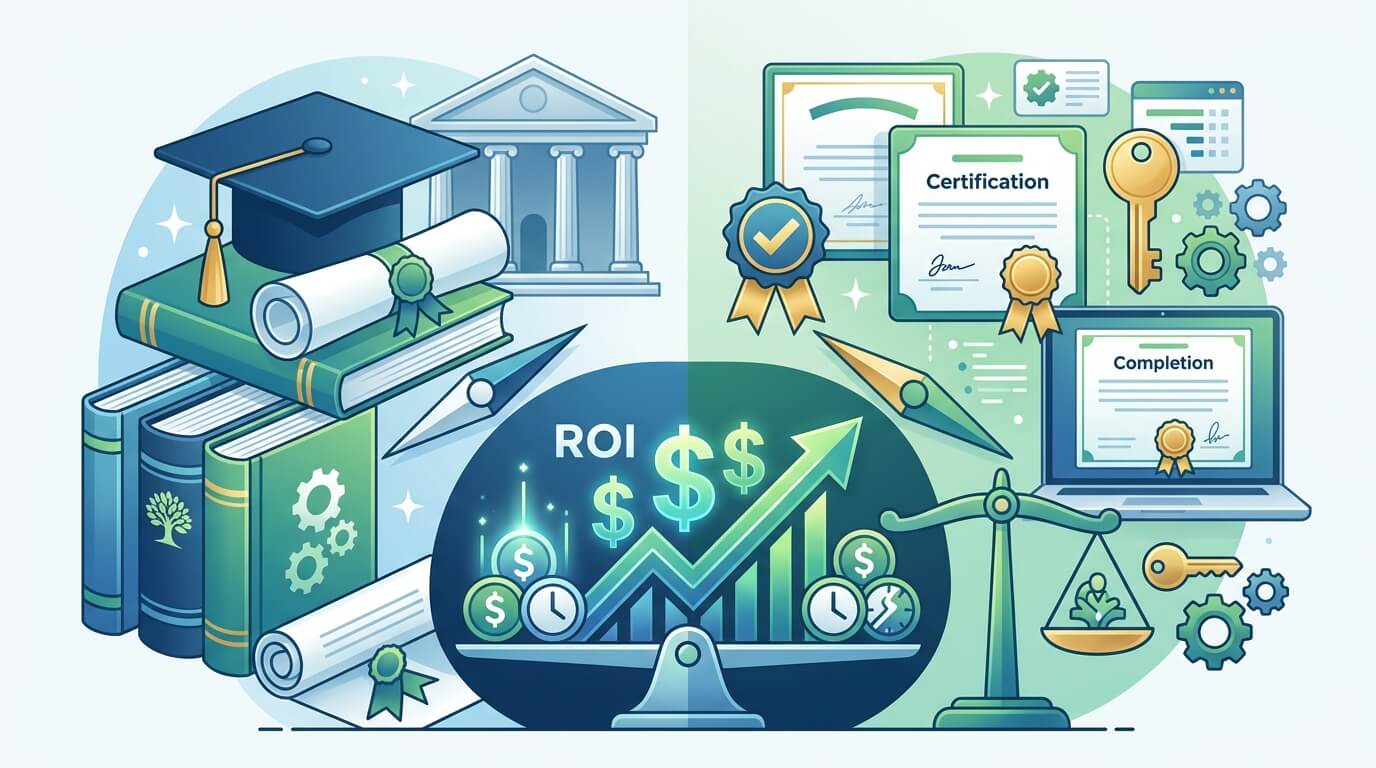
This isn’t about which option looks better on paper. It’s about return on investment. A degree or certificate is a purchase, and you want to know what it buys you: income, stability, and room to grow. Tuition keeps rising. Job skills change faster than ever. Together, these make this decision far weightier than it was ten years ago.
Here’s the good news. Both routes can lead to a strong career path, as long as you match your choice to the right industry. Practical career advice from experienced professionals can also show you which skills, qualifications, and training employers value most in your target field.
What the Data Says About Certifications
Certifications have quietly become a serious contender in the Philippines. They’re no longer just a backup plan.
- The Technical Education and Skills Development Authority (TESDA) reports that the employment rate of technical-vocational graduates jumped to 83.34% in 2024, up from 79% the year before, based on the agency’s latest graduate tracking study.
- By mid-2026, job placement for tech-voc completers had climbed even higher, according to figures shared during this year’s presidential address.
- Certifications also get you job-ready faster. Many programs take a few months, not years, so you start earning sooner.
Welding, electrical work, culinary arts, digital marketing, and IT support often reward skills over diplomas. If you’re eyeing one of the best careers in a trade or tech-support role, a focused certificate can get you there fast.
Where a Degree Still Wins
Some careers simply demand a college degree. That’s not a preference. It’s the law.
The Professional Regulation Commission oversees more than 40 regulated professions, including nursing, engineering, accountancy, and teaching. As the commission’s own service charter makes clear, you can’t legally practice in these fields without a degree and a passed board exam. If your dream job sits inside one of these professions, a degree isn’t optional.
Degrees also tend to open doors to leadership and specialist roles over time. National development targets even track this trend. According to official labor and education planning data, the government aims to shrink the share of college graduates stuck in low-skill jobs. The takeaway? A degree still pays off, especially in fields with long, structured career ladders.
Degree vs. Certification: Comparing the Real Costs
Money often tips the scale, so let’s talk numbers.
- Private college tuition in the Philippines can run roughly ₱30,000 to ₱150,000 per year, before books, transportation, and housing.
- State universities and TESDA programs are now free for many students. Under the free tuition law, qualified Filipinos can attend public colleges and state-run technical schools without paying tuition.
- Certifications usually cost far less overall and take months, not years, to finish.
- Opportunity cost counts, too. Every year in school is a year without a full salary. A shorter program lets you build income and experience sooner.
Neither option is automatically cheaper. The real cost depends on your school, your scholarship options, and how long you plan to stay in your field.
What Employers Actually Look for Now
Hiring is changing, and the shift favors skills more than ever.
Recent global hiring research found that a skills-based approach can expand a company’s talent pool by more than six times. Why? Employers stop screening out capable people who simply lack a specific diploma. Meanwhile, a major global jobs forecast warns that many of today’s job skills will need updating within just a few years, based on a survey of over a thousand employers worldwide.
For Filipino professionals, the message is clear. Whatever path you choose, your learning doesn’t end at graduation. Short courses, certifications, and skill upgrades matter, even if you already hold a degree.
A Simple Framework to Help You Decide
Ask yourself these five questions:
- Is the profession regulated by law? If yes, you need a degree and, often, a license.
- How fast do skills change in this field? Fast-moving fields like tech and digital marketing often reward certifications and ongoing learning over a single degree.
- What’s your payback period? Compare the total cost against your expected starting salary to see which path earns back its cost faster.
- Do you want to specialize or lead later? Long-term leadership tracks often still favor a degree.
- Can you combine both? Many successful Filipino professionals hold a degree and stack certifications on top for an extra edge.
Frequently Asked Questions
Is a certification better than a degree in the Philippines?
Neither wins across the board. Certifications work well for trades, IT, and digital marketing, while regulated professions like nursing, engineering, accountancy, and teaching require a degree and a license.
Can you land a good job with just a certification?
Yes. TESDA data shows that 83.34% of tech-voc graduates found work in 2024, and more employers now hire based on skills rather than diplomas.
Should you get both a degree and certifications?
Often, yes. A degree builds a strong foundation, while certifications keep your skills current in a fast-changing job market.
No Single Winner
The degree vs. certification debate has no single winner. The smartest path matches your goals, your budget, and the real requirements of the job you want. Treat this decision like any investment. Look at the numbers, check the legal requirements, and consider how fast your industry moves. Do that, and whichever path you choose, you’ll build your future on facts, not guesswork.
Your Education Is Just the Beginning
Whether you choose a degree, a certification, or both, your next step is putting your skills to work. John Clements connects Filipino professionals with career opportunities across industries and offers recruitment and career support to help you move forward with confidence.
Ready to turn your skills into your next career move? Explore our current job openings and land your dream job sooner than you think!

