

I didn’t expect a birthday party to teach me anything about global trade. But that’s exactly what happened when I flew out for Angelena Cala’s 60th birthday celebration in Spain. What began as a personal milestone, surrounded by friends who had crossed continents to be there, slowly turned into something bigger in my mind: a window into why Spain is becoming one of the most compelling business partners the Philippines has right now.
A Weekend That Became More Than a Celebration
I went to Spain to celebrate a friend. I came home thinking about renewable energy, ports, and public-private partnerships. That’s the strange thing about gatherings like this one — they make room for history without getting trapped by it, and they turn a destination into more than a backdrop. Over that long August weekend, I kept noticing how naturally the personal and the professional intertwined, and how much Spain itself seemed to be quietly proving a point. This country is no longer just a place people visit. It’s a place people invest in, build with, and partner with.
Spain’s Economic Momentum: Beyond the Beaches
For a long time, I associated Spain almost entirely with tourism, and for good reason. Tourism-related activity generated €200.7 billion in 2024, equivalent to 12.6% of Spain’s GDP, according to Spain’s National Statistics Institute (INE). That’s a genuinely strategic asset, not a footnote.
However, I realized during my trip that tourism is no longer the whole story. Business services, transport, finance, digital activities, food and beverage exports, automotive manufacturing, infrastructure, and renewable energy now all play meaningful roles in the Spanish economy. Services exports rose strongly in 2024, and Spain’s position as a leader in wind and solar development has created a substantial investment pipeline in generation, grids, storage, and electrification.
Looking ahead, the outlook stays positive, though more measured. The European Commission projected real GDP growth of 2.4% in 2026 and 1.9% in 2027. Of course, Spain still faces real challenges — higher energy prices, inflation pressure, housing affordability, productivity gaps, demographic change, climate resilience, and public-finance management all remain on the table. Even so, Spain enters this next phase with real strengths: a diversified services economy, world-class companies, an internationally competitive tourism sector, and deep clean-energy potential.
The Corporate Titans Behind Spain’s Global Reach
The more I thought about it, the more I understood that the Spain I was celebrating wasn’t a small, insular economy. It’s represented by companies whose reach extends far beyond the peninsula.
Banco Santander and BBVA operate as international banking groups with a significant footprint across Europe and the Americas. Inditex, best known through Zara and its portfolio of global fashion brands, has made Spanish design and retail logistics familiar on high streets around the world. Iberdrola stands as a global force in renewable electricity and power networks, while Repsol continues reshaping its portfolio across conventional and lower-carbon energy. Telefónica remains an important telecommunications and digital-services group, especially across Europe and Latin America.
Infrastructure is another Spanish calling card I hadn’t fully appreciated before. Groups such as ACS and Ferrovial have developed international expertise in transport, construction, airports, roads, engineering, and public-private partnerships. Together, these companies reflect a broader national pattern: Spain’s corporate champions are highly international, and many have learned to operate across different regulatory, cultural, and geographic environments.
That global orientation, I realized, is particularly relevant to the Philippines.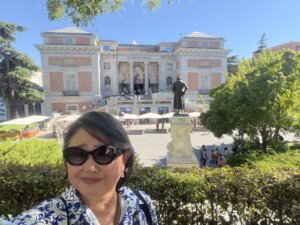
Why the Philippines and Spain Make a Natural Match
The Philippines and Spain share a historical link that goes back centuries. What struck me during that weekend, though, was the opportunity sitting right in front of us: turning that shared past into a forward-looking commercial and institutional partnership.
The Philippines can offer Spanish businesses a compelling base in Southeast Asia — a young population, a growing consumer market, English-language fluency, a large business-process outsourcing and IT-services workforce, and access to the broader ASEAN region. Meanwhile, Spain can offer Philippine businesses a gateway to the European Union, along with deep experience in renewable energy, transport, water, tourism, hospitality, consumer retail, and international infrastructure delivery.
Several practical opportunities stood out to me as genuinely actionable:
- Renewable Energy and Storage
Spanish developers, utilities, and engineering firms bring proven experience in solar, wind, grid modernisation, and battery storage. Meanwhile, the Philippines needs clean-power capacity, resilient grids, and solutions suited to an archipelagic geography. - Water, Waste, and Climate Resilience
Spanish expertise in water treatment, desalination, wastewater systems, and urban infrastructure can support Philippine priorities in water security, flooding, and sustainable city development. - Ports, Shipping, and Logistics
Spain’s port and logistics capabilities can complement Philippine needs for more efficient domestic connectivity and stronger links to global trade routes. - Transport and Public-Private Partnerships
Rail, airports, roads, urban mobility, and infrastructure project delivery remain natural areas for Spanish–Philippine collaboration. - Digital Services and Cybersecurity
Spain’s telecommunications, fintech, and smart-city capabilities can pair effectively with the Philippines’ established BPO, IT, and English-language talent base. - Tourism, Food, Education, and Creative Industries
Both countries share powerful hospitality cultures. Collaboration can extend from tourism investment and culinary exchange to education, heritage, retail, and cultural programming.
A Bridge Already Being Built
None of this is purely theoretical, either. The Philippine Trade and Investment Center in Madrid has been actively encouraging these connections, and Spanish interest in Philippine rail, water treatment, modern vessels, port facilities, renewable energy, energy storage, and related infrastructure tells me this agenda is already emerging, not just imagined.
The Real Takeaway From That August Weekend
At its core, Angelena Cala’s celebration was personal. It marked turning 60 surrounded by people who chose to travel far just to be present. Still, it offered me an elegant reminder of what gatherings can do when they’re thoughtfully designed. 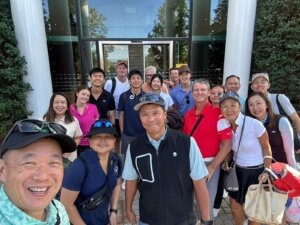

They make room for history without becoming trapped by it; make business context feel human and turn destinations into stories. And they show that a global network isn’t only a list of countries or professional affiliations — it’s a community of people willing to take a flight, walk a fairway, raise a glass, share a meal, and celebrate someone they value.
If you’re curious about how gatherings like these continue to shape leadership and connection among Filipina executives, our recent piece on the Filipina CEO Circle explores the same idea from another angle.
Through the looking glass of that long August weekend, Spain appeared to me not just as a destination but as a bridge — between heritage and modernity, Europe and Asia, personal milestones and future opportunities. At the centre of it all was Angelena, celebrated not only for the years she has lived, but for the extraordinary circle of friendship she has created along the way.
Follow our blog, Lookingglass, for more insightful articles.

