
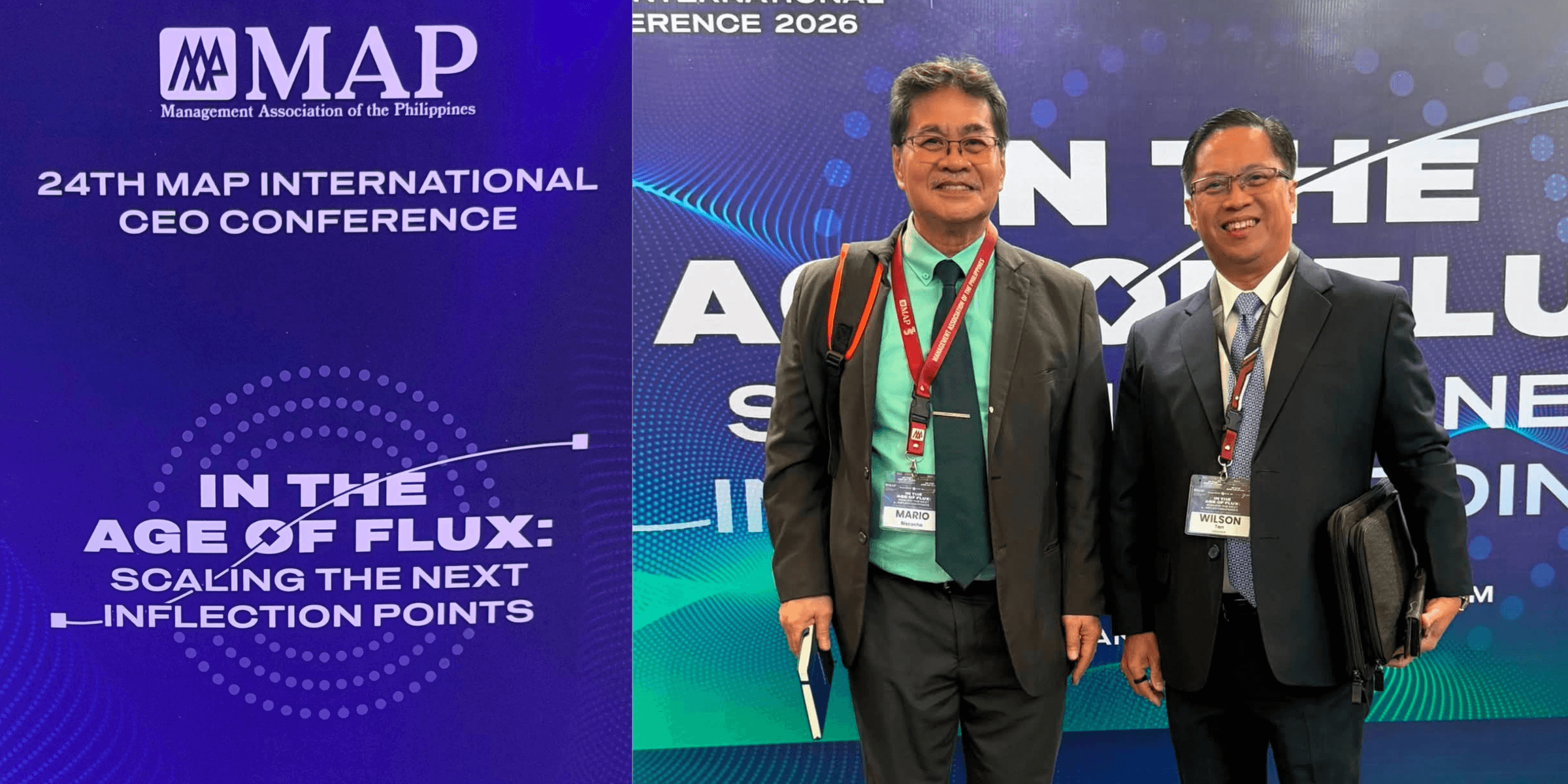
The 24th MAP International CEO Conference held on September 8, 2026, at Shangri-La The Fort gathered global thought leaders and business executives to explore how organizations can succeed amid geopolitical, technological, and economic shifts. Guided by the theme, “In the Age of Flux: Scaling the Next Inflection Points,” the event encouraged leaders to move beyond adaptation and take an active role in shaping the future. For Philippine business leadership, the discussions offered practical frameworks for navigating disruption while capturing emerging opportunities.
The morning sessions featured insights from Dr. Kunihiko Hirabayashi (Secretary General, ASEAN-Japan Centre), Lionel Yeo (Independent Director, Singapura Finance Limited), Stavros Lee (CEO & Co-Founder, Oncade), and Dallas Dolen (Technology, Media & Telecommunications Leader, PwC US). Collectively, their presentations emphasized resilience, innovation, and long-term value creation.
Reconfiguring the Future Through Regional Cooperation
ASEAN’s Role in a Changing Global Landscape
In his presentation, “The New Geometry of Change: ASEAN’s Place in a Reconfigured World,” Dr. Hirabayashi argued that the world is not simply experiencing disruption. Instead, it is undergoing a profound restructuring. Consequently, leaders must help shape emerging realities rather than wait for stability to return.
He highlighted the importance of the Regional Comprehensive Economic Partnership (RCEP), one of the world’s largest trade agreements, as a platform for regional growth and deeper economic integration. Through streamlined trade mechanisms and wider market access, RCEP presents significant opportunities for the Philippines.
For reference:
However, Hirabayashi stressed that frameworks alone do not create impact. Organizations must translate policy into practical benefits for businesses and communities.
Key priorities include:
- Expanding opportunities for MSMEs
- Supporting women entrepreneurs
- Encouraging startup growth
- Developing young innovators
- Strengthening regional collaboration
His central message was clear: transformation succeeds when people become active participants in change. This insight carries particular relevance for Philippine business leadership as organizations seek growth across increasingly interconnected markets.
Navigating a BANI World
Leading Through Fragility and Uncertainty
A major highlight of the conference was Lionel Yeo’s discussion of the modern operating environment. He encouraged executives to distinguish between imperatives and choices.
Imperatives include:
- Regulatory compliance
- Organizational values
- Critical risk management
Choices include:
- Strategic positioning
- Innovation priorities
- Competitive differentiation
Furthermore, Yeo argued that the traditional VUCA framework no longer provides a complete picture of current realities. Instead, organizations now operate in a BANI world, characterized by conditions that are:
- Brittle
- Anxious
- Nonlinear
- Incomprehensible
According to Yeo, climate risks, geopolitical tensions, rapid technological shifts, and social instability have increased uncertainty across industries.
To respond effectively, organizations should:
- Build operational resilience through diversification
- Strengthen workforce agility
- Promote transparency and psychological safety
- Invest in scenario planning
- Encourage continuous learning
In contrast to traditional efficiency-focused strategies, modern organizations must prioritize adaptability and collaboration. As a result, Philippine business leadership must balance stability with flexibility to remain competitive in a rapidly evolving marketplace.
From Technology Adoption to Outcome Creation
Turning Innovation into Real Business Value
Stavros Lee shifted the discussion toward emerging technologies and their effect on business models. In his presentation, “From Technology to Trajectory,” he emphasized that technology should serve as a catalyst for growth rather than an objective on its own.
Lee warned leaders against falling into the “tool trap,” or the assumption that technology adoption automatically creates competitive advantage. Specifically, he noted that artificial intelligence is dramatically lowering the cost of producing code, research, presentations, and other forms of knowledge work.
As AI handles more routine tasks, human contribution will increasingly center on:
- Strategic judgment
- Creativity
- Relationship building
- Complex decision-making
Therefore, organizations should focus on outcomes instead of effort alone.
Lee also highlighted the growing potential of programmable money and stablecoins to reduce transaction friction and improve cross-border payments. These developments could support the continued evolution of the country’s digital economy.
Additional resources:
For Philippine business leadership, the key question is no longer whether to adopt technology. The real challenge is determining how technology can generate measurable business outcomes and sustainable value.
Building Resilience and Strategic Optionality
Investing Ahead of Change
Closing the conference’s keynote presentations, Dallas Dolen examined how organizations can strengthen resilience amid major shifts in geopolitics, artificial intelligence, technology investment, and capital flows.
He emphasized the interconnected nature of the global technology ecosystem and highlighted the Philippines’ role in assembly and testing within the broader semiconductor value chain. At the same time, he noted that large-scale AI investments deliver value only when they produce clear business results.
Dolen encouraged organizations to focus on several “no-regret” capabilities:
- Data management
- Cybersecurity
- Talent development
- Digital infrastructure
- Ecosystem partnerships
Furthermore, he stressed that responsible AI governance, strong security controls, and human oversight must accompany technological advancement.
His closing message resonated strongly with attendees. The greatest risk is not uncertainty itself. The greatest risk is waiting too long to act.
That perspective offers an important lesson for Philippine business leadership, which must often make decisions amid incomplete information and rapidly changing market conditions.
A Call to Shape the Future
The conference delivered a powerful message: resilience, innovation, regional collaboration, and strategic courage are no longer optional leadership traits. They are essential capabilities for long-term success.
Whether organizations are navigating a BANI world, leveraging artificial intelligence, unlocking opportunities through RCEP, or building more adaptable operations, the challenge extends beyond responding to change. Leaders must help create what comes next.
Ultimately, Philippine business leadership will succeed by embracing uncertainty, making informed decisions, and investing ahead of disruption. Those who act with conviction while maintaining flexibility will be best positioned to shape the next wave of growth and transformation.
Build a Future-Ready Workforce
Looking to strengthen your leadership pipeline, workforce strategy, or organizational capabilities? Connect with us at John Clements Consultants today.

