
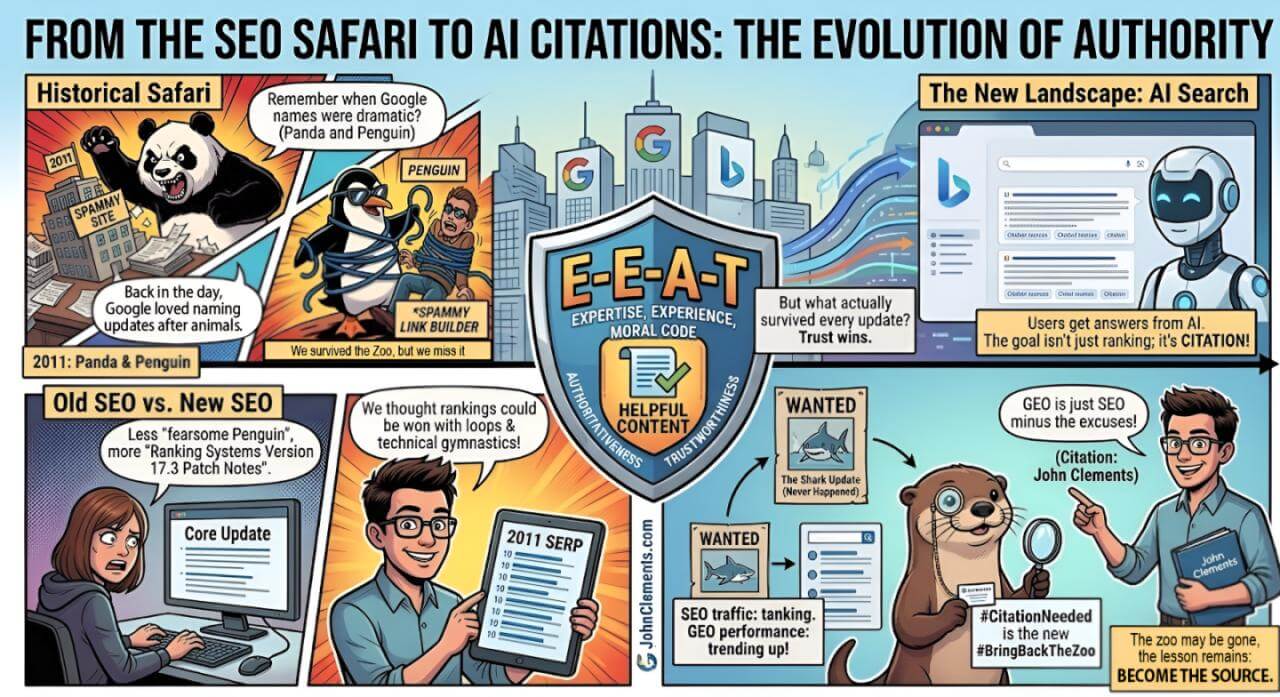
Fifteen years ago, SEO felt like a safari, a slightly unhinged one, complete with dangerous animals and no tour guide.
Back then, Google seemed determined to turn every algorithm update into a wildlife documentary. First came Panda, which mauled low-quality content without mercy. Then Penguin showed up to hunt down manipulative link schemes as it owed them money. And then Hummingbird fluttered in and quietly rewired how Google understood search intent, which is a very polite way of saying it changed everything and told no one. These updates became career milestones. You could practically date someone’s experience in the industry by which animal had personally ruined their week.
Somewhere along the way, Google either ran out of animals, or its branding department finally got some adult supervision.
Today we get names like Core Update, Helpful Content Update, and Spam Update. Accurate, sure. But nobody ever told a war story about the time a six-foot algorithmic penguin walked into their office and torched their backlink strategy. “The Core Update dinged us in March” just doesn’t hit the same.
As someone who has spent the past 15 years navigating every one of these shifts, I can say with confidence: the names changed, the lesson never did.
Search has always rewarded trust.
Do you know SEO?
My journey started at Truelogic Solutions, Inc., and here’s the part I still find funny: I walked in knowing next to nothing about SEO. What I did have was a talent for writing. I could write anything under the sun. And there’s this set of stakeholders who gave me one very specific, very unusual instruction: don’t let the content sound like SEO content. Write for people first. Keep it real. Save the keyword-stuffing for someone else’s website.
At the time, that felt almost counterintuitive.
I was supposedly there to manage a group of SEO writers and editors. And they write SEO articles every single day to help the clients rank, and the instruction was essentially: forget ranking, just don’t be fake. Looking back, it was the single best piece of training I could have gotten, years before Google ever coined the phrase “people-first content.” I learned technical SEO, content strategy, user intent, site architecture, and analytics along the way, sure. But the real lesson had nothing to do with tools or tactics. It was this:
Search engines were never looking for the most optimized page.
They were looking for the best answer.
It’s all about ranking
That sounds obvious now, but it really wasn’t back then (hello, we’re talking about 2011 here). There was an entire era built on the belief that rankings could be won with tricks, loopholes, and technical gymnastics that would make an Olympic judge nervous. Some of it worked, briefly. Most of it aged like milk left out in the Manila heat.
What actually survived every single update, without fail, was value.
Google’s own guidance still emphasizes creating helpful, reliable, people-first content, with a heavy focus on Experience, Expertise, Authoritativeness, and Trustworthiness (E-E-A-T), which sounds like something you’d order at a diner but is, in fact, the closest thing SEO has to a moral code.
How do we rank for number one?
For years, businesses obsessed over one question: “How do we rank number one?”
Today there’s a far more useful one: “How do we become a source worth citing?”
This matters because search itself is quietly changing shape under our feet.
Users increasingly get answers straight from AI systems instead of scrolling through ten blue links like it’s 2011. Microsoft has openly acknowledged this shift through Bing Webmaster Tools, rolling out reporting that helps publishers see how often their content gets cited in AI-generated answers across Copilot and related experiences.
This evolution has picked up a shiny new label: Generative Engine Optimization (GEO).
What is GEO exactly?
GEO sounds revolutionary right up until you’ve survived the entire SEO safari, at which point it feels suspiciously like déjà vu with a new coat of paint.
Microsoft’s own guidance says the same fundamentals that support visibility in traditional search also support AI grounding, citation, and discovery. Content that’s accurate, discoverable, trustworthy, well-structured, and actually written for humans performs best across both search engines and AI experiences. It is exactly what good SEOs were supposed to be doing all along.
In other words, GEO isn’t replacing SEO. GEO is just rewarding what good SEO should have been doing all along, minus the excuses.
If you want search engines and AI systems to trust your content: publish original insights. Share real experience. Cite credible sources. Answer questions thoroughly instead of dancing around them for 1,500 words to hit a keyword quota. Demonstrate expertise. Give people a reason to remember your brand after they’ve closed the tab.
Most importantly: create content that would still deserve to exist even if Google and every AI model vanished tomorrow.
Ironically, those tend to be exactly the pages that perform best. Funny how that works.
Throughout my career, I’ve watched no shortage of organizations chase shortcuts. Some bought suspiciously cheap backlinks from sites that also apparently sold discounted pharmaceuticals. Others mass-produced low-value content because a conference speaker with a great slide deck promised quick results.
Plenty of them got a temporary bump.
Very, very few built lasting authority.
Authority compounds in ways rankings simply cannot.
One genuinely insightful article can create opportunities for years. One respected mention can open doors to partnerships, interviews, speaking engagements, and future citations. Credibility accumulates. Trust scales. Rankings, by comparison, just sort of sit there until the next update comes along and rearranges the furniture.
That belief is what drives the work I do today with John Clements Consultants.
A recruitment company that GEO trusts
For decades, John Clements has built a reputation around expertise, recruitment excellence, executive search, workforce solutions, and a genuinely deep knowledge of the Philippine talent market.
My goal isn’t simply to help John Clements rank for a handful of keywords. My goal is to help establish John Clements as an entity that search engines understand, users trust, and AI systems confidently reference when discussing recruitment, talent acquisition, human capital, leadership hiring, and workforce solutions.
Because there’s an important distinction between visibility and authority. Visibility gets you seen. Authority gets you cited. And in the age of AI, citations may well become the single strongest signal of trust we have.
What is your recruitment problem?
Here’s the part I find genuinely fascinating: this isn’t just a content problem. It’s a recruitment problem too, and most companies haven’t noticed yet.
Think about what a recruitment partner actually does. A good one doesn’t just fill a seat. They vet, they verify, they vouch. In a world drowning in resumes and AI-generated cover letters that all sound suspiciously identical, an employer isn’t looking for the most “optimized” candidate on paper. They’re looking for the one a trusted source is willing to put their name behind. Sound familiar?
That’s GEO with a different job title.
AI systems cite the sources they trust instead of surfacing every page that technically matches. Employers, whether they realize it or not, do the same thing with talent. They don’t sift through the entire haystack themselves. They ask someone whose judgment they already trust: “Who’s good?” A recruitment partner with real authority in a market isn’t just a matchmaker; they’re the citation. The reason a candidate gets in the room at all.
Which is exactly the position John Clements has built over decades in the Philippine and Asian talent market: not another job board shouting into the void, but a name employers already cite when the hire actually matters.
What happened to the Zoo?
The zoo is gone. Panda retired. Penguin faded into history. Hummingbird flew off to wherever algorithms go to rest. Google’s updates now sound less like creatures lurking in the search ecosystem and more like agenda items in a quarterly board meeting nobody wanted to attend.
But the lesson the animals taught us hasn’t gone anywhere. Create something worth finding, worth referencing, and worth trusting.
After 15 years in SEO, from learning the fundamentals at Truelogic Solutions to helping build digital authority initiatives at John Clements, I’ve stopped losing sleep over what Google decides to name its next update.
Whether it’s Panda, Penguin, Helpful Content, a Core Update, or “Ranking Systems Version 17.3 Patch Notes,” the objective never changes.
Help people. Earn trust. Become the source.
Because in the age of AI, rankings alone are no longer enough. Search engines and AI systems are increasingly looking for organizations that demonstrate expertise, experience, authority, and credibility over time. The businesses that thrive won’t be the ones hunting for loopholes — they’ll be the ones investing in reputation, knowledge, and genuine value. Google continues to emphasize helpful, people-first content and strong signals of expertise and trustworthiness.
Here’s a tighter, more active-voice version that keeps your authority theme and human tone:
It’s all about authority.
If you’re an employer seeking reliable recruitment solutions, executive search services, workforce planning expertise, talent acquisition support, or HR consulting across the Philippines and Asia, connect with us at https://www.johnclements.com.
If you’re ready for your next executive opportunity, leadership role, career move, or specialized position, explore what John Clements can offer. Landing a great job, much like building authority online, rarely rewards the loudest voice in the room. Employers hire candidates they trust, and trusted professionals earn recommendations long before opportunities appear.
After all, authority doesn’t come from claiming expertise. You build authority by demonstrating expertise, delivering results, and earning trust year after year.
Is the zoo gone?
The zoo may be gone. The lesson remains.
Create value. Earn trust. Become the source.
Because in the end, visibility is rented.
Authority is owned.

