

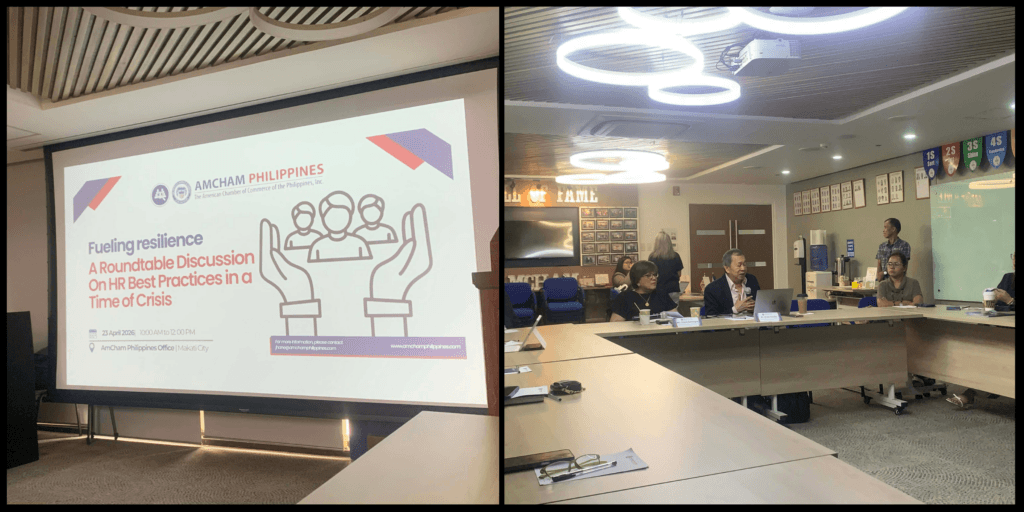
In an era defined by volatility and rapid change, human resource (HR) leaders are increasingly called to go beyond traditional workforce management and step into strategic leadership roles. This was the central theme of the recent AmCham HR Committee Meeting – HR Best Practices Amid Crisis hosted by the American Chamber of Commerce of the Philippines, where HR practitioners and business leaders gathered to exchange insights on navigating uncertainty.
The discussion featured thought leaders including Ernie Cecilia and Grace Sorongon, who shared valuable perspectives on how organizations can strengthen resilience, support employees, and sustain business continuity during crises.
Navigating a World of Increasing Uncertainty
The session opened with a clear acknowledgment of today’s complex global environment. Organizations are currently operating amid overlapping disruptions—geopolitical tensions, supply chain instability, energy price fluctuations, inflationary pressures, and accelerating climate risks. These factors collectively shape a business environment that is unpredictable and highly sensitive to change (Philippine Statistics Authority).
To better describe this reality, the discussion introduced the BANI framework: Brittle, Anxious, Nonlinear, and Incomprehensible. Unlike traditional models of stability, BANI reflects the fragility and unpredictability of modern systems, where small disruptions can lead to significant consequences.
Consequently, HR leaders are expected to develop stronger adaptability, emotional intelligence, and strategic foresight to help organizations remain resilient.
HR at the Center of Crisis Management
A key takeaway was the evolving role of HR as the first line of defense in organizational crises. Beyond administrative functions, HR is now expected to play a critical role in managing employee sentiment, ensuring business continuity, and supporting leadership decisions.
Crises are no longer viewed solely as operational disruptions but as tests of leadership capability and organizational culture. Employees often experience heightened anxiety related to job security, financial stability, and organizational direction. In this space, HR becomes the bridge between leadership intent and employee experience.
Grace Sorongon emphasized that HR’s value lies not in always having solutions, but in maintaining presence, clear communication, and consistency. These elements stabilize employee confidence during uncertain periods and reinforce trust in leadership.
Her insights underscored that HR’s role is not only operational but deeply human, grounded in empathy, accessibility, and continuous engagement with employees, especially when uncertainty is at its highest. This is the essence of HR crisis management.
Embedding ESG, SDG, and DEI in HR Strategy
The discussion highlighted the importance of aligning HR practices with global frameworks:
- Environmental, Social, and Governance (ESG)
- Sustainable Development Goals (SDG)
- Diversity, Equity, and Inclusivity (DEI)
These frameworks are no longer optional—they are essential pillars of organizational sustainability (United Nations SDGs). HR plays a crucial role in integrating these principles into talent management, employee engagement, and organizational culture.
Importantly, these frameworks help organizations balance competing priorities such as cost management, workforce resilience, and operational efficiency.
Practical HR Responses During Crisis: The ACE Framework
Grace Sorongon shared the ACE framework, developed through crisis experience during the COVID-19 pandemic:
- Actionable HR Programs – Strengthened employee support systems through check-ins, consistent engagement, and active communication.
- Communication – Centralized systems ensured timely and accurate updates, reducing uncertainty.
- Engagement – Structured learning, creative initiatives, and continuous growth opportunities sustained morale and productivity.
Additional support measures included employee assistance programs, distribution of essential goods, and partnerships with external suppliers to address employee needs. These practices remain vital in effective HR crisis management.
Leadership Principles for HR in Crisis
Ernie Cecilia emphasized guiding principles for HR professionals:
- Anticipate risks and seek expert insights
- Be aware of internal and external environments
- Accept the reality of crisis situations
- Adapt to non-linear and evolving conditions
- Act decisively even without complete information
- Accommodate employee needs with empathy and flexibility
- Accelerate transformation and use crisis as a catalyst for change
He stressed that inaction is often the greatest risk. HR must be prepared to make timely decisions even in imperfect conditions. Most importantly, HR was reaffirmed as the voice of employees in the boardroom, ensuring organizational decisions remain grounded in human impact.
Conclusion: Crisis as a Catalyst for HR Transformation
The AmCham HCR Committee Meeting reinforced a critical truth: crises, while disruptive, also serve as catalysts for transformation. They challenge HR leaders to rethink traditional approaches and adopt more agile, people-centered strategies.
In today’s volatile business landscape, HR is no longer just a support function—it is a strategic partner in shaping organizational resilience. By embracing adaptability, strengthening communication, and prioritizing employee wellbeing, HR can help organizations not only survive uncertainty but emerge stronger from it.
Ultimately, HR crisis management is about safeguarding employee wellbeing while sustaining business continuity.
Is your organization ready to strengthen resilience through HR crisis management?
Visit our Contact Us page today!

