

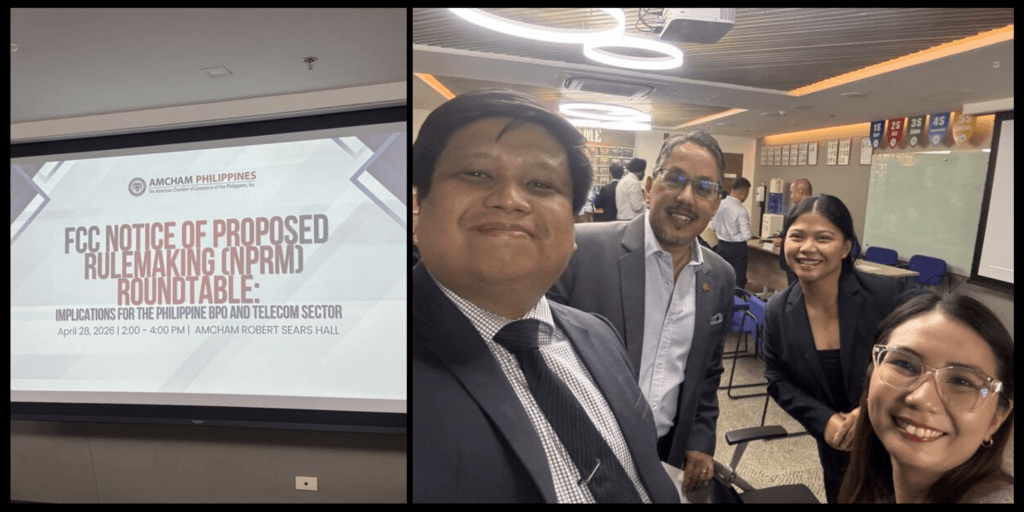
I attended a discussion hosted by the American Chamber of Commerce of the Philippines at the RS Hall in their headquarters, where industry leaders gathered to unpack the implications of the FCC Notice of Proposed Rulemaking (FCC 26-16).
At a high level, the NPRM is framed around improving customer experience and strengthening consumer protection in the US. Specifically, Atty. Mike Montero emphasized that the direction of the proposal points toward encouraging onshoring. It introduces possible limits on offshore delivery, requires disclosure when services are handled outside the US, and suggests tighter controls on sensitive transactions such as authentication and account access. While still under consultation, the timelines are tight and the outcomes will largely be shaped in Washington.
Reputational Concerns for Philippine BPO
For the Philippines, the concern is less about capability and more about how the narrative is being formed. Mark Lwin pointed out that the issue is not just regulatory, but reputational. The proposal appears to be grounded in fear and misperception—linking offshore delivery with poor service quality and fraud. This is a difficult narrative for the Philippine BPO industry, which has spent decades investing in compliance, training, and service excellence.
Several speakers challenged this assumption directly. Julian Valenzuela noted that fraud is often incorrectly attributed to location, when in reality it is driven by bad actors operating outside legitimate systems. This was echoed by Mitch Locsin, who highlighted that a significant portion of robocalls affecting US consumers do not originate from the Philippines at all; underscoring the risk of conflating unrelated issues. See official telecom data at https://ntc.gov.ph.

Business Realities of Onshoring
From a business standpoint, the operational realities of onshoring were also brought into focus. Amit Jagga shared that global delivery models exist for a reason—balancing cost, talent, and scalability. Attempts to move large-scale operations onshore often face challenges in talent availability and attrition, ultimately driving up costs. Consequently, these costs will not disappear; they will be passed on to consumers.
At the same time, there was recognition that the shifting sentiment in the US is real. Sara Murphy noted that organizations are already facing increased internal pressure to justify offshore operations. In some cases, the regulatory burden alone may be enough to prompt companies to reconsider their delivery models, even if the Philippine BPO sector continues to perform well.
Broader Regulatory Risks
The discussion also surfaced a broader concern: this may not stop at telecommunications. As raised by multiple speakers, including Lwin and Valenzuela, this could be the start of a wider regulatory trend that extends into other sectors such as healthcare and financial services. For reference, see https://www.doh.gov.ph for healthcare regulations.
Despite these concerns, the tone of the conversation was not defensive. There was broad agreement that consumer protection is a valid objective. In contrast, the challenge is ensuring that regulation is based on risk and evidence, not geography.
Call for Engagement
The NPRM remains in its consultation phase, which presents a critical window for engagement. As Atty. Montero highlighted, this is the time for industry groups and stakeholders to align, articulate their position, and ensure that the Philippine BPO sector is properly represented in the conversation.
Key Takeaways
- Regulatory pressure is increasing in the US.
- Reputation management is critical for Philippine BPO firms.
- Onshoring challenges include talent shortages and higher costs.
- Broader risks may extend into healthcare and finance.
- Active engagement in consultation is essential.
The takeaway is clear: the fundamentals of the Philippine BPO industry remain strong. But in an environment where perception can shape policy, maintaining that position will require not just continued execution—but a more deliberate effort to influence how the story is told.
The future of the Philippine BPO sector depends on proactive engagement and narrative control. Industry leaders must act decisively to shape perception, influence policy, and safeguard competitiveness in a shifting global environment.
Contact us today at John Clements to explore how we can help your organization navigate regulatory challenges and strengthen its position in the outsourcing landscape.

