

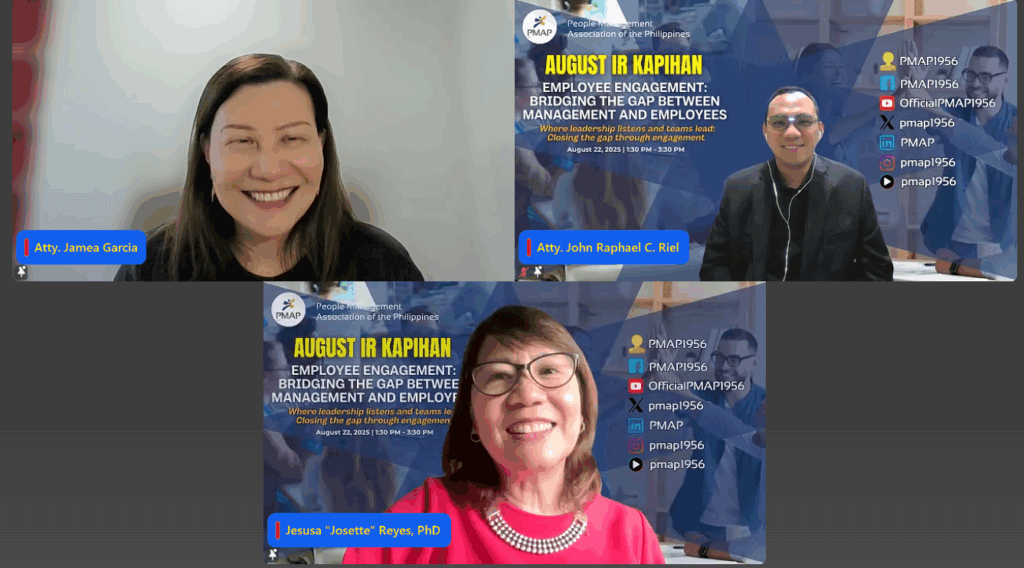
During the August IR Kapihan of the People Management Association of the Philippines (PMAP), Atty. Jamea Garvia, Senior Vice President of Human Resources at Sagility, delivered timely insights on how organizations can strengthen employee engagement in a changing workplace. Drawing from industry studies and her own experience, she highlighted that engagement today is not about mere attendance or isolated activities; it is about bridging perception gaps, making impact measurable, and creating a culture that inspires purpose.
The Perception Gap
Research by SHRM, Willis Towers Watson, and Great Place to Work reveals a recurring misalignment between leaders and employees. For leaders, engagement often translates into productivity and cost-efficiency. Some even see engagement initiatives as programs designed for entry-level staff rather than for themselves. Employees, meanwhile, value recognition, support, and opportunities for growth.
When leaders appear absent from activities, employees question their importance, asking, “If my manager isn’t even joining, why should I?” This misalignment creates what Atty. Garvia calls a perception gap, a disconnect that weakens both morale and organizational culture.
Measuring Engagement
A central point from the discussion was that engagement must be measurable. Attendance alone is not a valid metric. Instead, Employee Net Promoter Scores (eNPS) and Employee Satisfaction (eSAT) provide clearer measures of whether employees feel connected and supported. More importantly, engagement outcomes must be linked to business performance. As Atty. Garvia explained, it is not sustainable for business results to climb while employee experience declines. True engagement balances both success and well-being.
Bridging the Gap
To address these challenges, organizations must adopt strategies that bring leaders and employees closer together. Creating open platforms for dialogue ensures that feedback flows both ways. Aligning goals with employees’ personal aspirations strengthens accountability, while leadership visibility, particularly among first-line supervisors, sets the tone for team culture.
Engagement also works best when employees are co-creators, involved in designing recognition programs, wellness initiatives, and team activities. Transparent communication and reverse feedback channels reinforce trust, while values-based recognition and cross-functional collaboration promote a stronger, more unified culture. These practices move engagement away from being activity-driven toward becoming mindset-driven.
Multigenerational Engagement
Another critical dimension is the multigenerational workforce. Atty. Garvia emphasized that strategies should reflect where employees are in their career journeys. Early-career employees value mentoring and skills development, mid-career employees seek recognition and leadership paths, while senior employees look for meaningful transitions, legacy-building, and continued respect. Recognizing these different needs not only improves engagement but also helps reduce attrition across all levels.
Why Engagement Matters
Engagement is not an optional initiative; it is a driver of business performance. Studies show that highly engaged organizations experience 43% lower turnover, while empowered employees are five times more likely to go the extra mile. Recognition and growth consistently rank as top retention drivers, often outweighing salary. As Atty. Garvia noted, employees who do not see growth or recognition will ultimately leave, regardless of pay.
From Activities to Culture
The key, therefore, is to build a culture of engagement, not a checklist of activities. Engagement should not feel like a routine task but must be rooted in organizational values and personal meaning. Purpose-driven programs illustrate this shift. At Sagility, for example, wellness activities such as fun runs are integrated with corporate social responsibility, with portions of registration fees donated to schools and charities.
Employees join not just for fitness but because they feel their participation contributes to a greater cause. As Atty. Garvia noted, tokens and incentives matter, but purpose sustains genuine engagement.
A Shared Responsibility
Finally, engagement cannot rest on HR alone. While HR provides data and insights, it is the shared responsibility of leaders at every level to act on them. Supervisors, in particular, carry the heaviest influence over employee experience. If they are disengaged, their teams will be too. Embedding engagement into leadership accountability by linking employee satisfaction to performance metrics ensures that business results and employee well-being are pursued together.
The future of work demands a new approach to engagement. Organizations must close perception gaps, measure impact meaningfully, and embed purpose into daily practice. By listening first, co-creating strategies, and aligning business success with employee experience, companies can transform engagement from an activity into a culture.
Because in the end, the goal is not just to ask employees to attend; it is to give them a reason to belong.
Turn Engagement into Lasting Success
Employee engagement isn’t just a buzzword—it’s the foundation of a thriving workplace. If you’re ready to put proven engagement strategies into action, John Clements Consultants can help. From tailored HR solutions to innovative outsourcing services, we empower businesses to build stronger, more connected teams.
Contact us today and start shaping a workplace where people love to contribute.

