

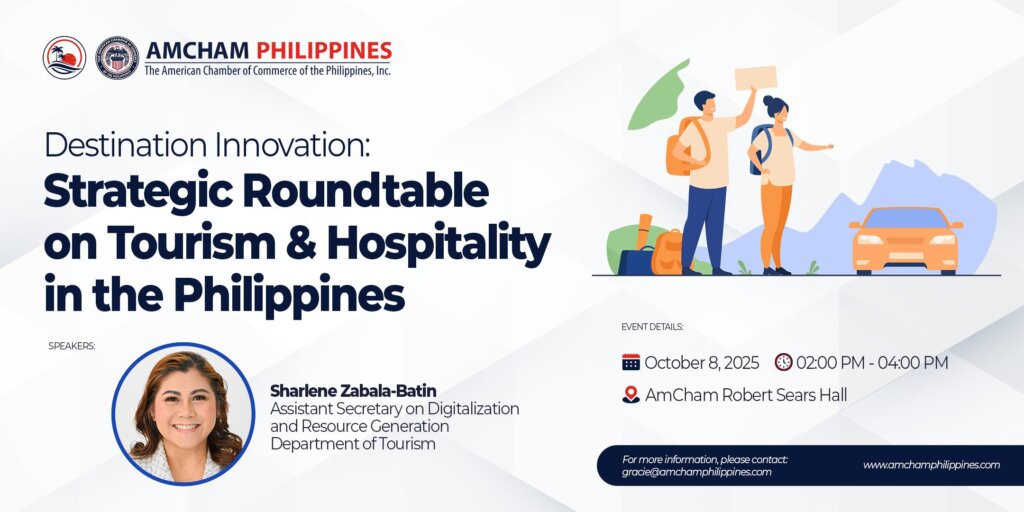
The tourism sector is one of the Philippines’ strongest economic drivers — and the recent “Destination Innovation: Strategic Roundtable on Tourism & Hospitality in the Philippines” held on October 8, 2025, at AmCham Robert Sears Hall, Makati City, clearly showed that this momentum is only getting stronger. The event gathered industry leaders, policy makers, and private sector representatives to discuss the next phase of tourism growth and innovation in the country.
A Tourism Industry on the Rise
The Department of Tourism (DOT) presented compelling data underscoring the sector’s resilience and dynamism. Domestic tourism expenditures reached PHP 3.16 trillion, marking a 16.4% increase from 2023, while inbound tourism hit PHP 699.98 billion, up by 0.4%. Notably, outbound tourism posted the highest growth at 37.5%, amounting to PHP 345.68 billion.
Beyond the numbers, what stood out to me was the strategic focus on positioning Metro Manila as a key tourism gateway. Launching this October 21, this initiative aims to enhance the travel experience for both local and international tourists through curated digital experiences and trusted traveler support. It’s a forward-looking move that blends infrastructure with smart technology — a necessity for global competitiveness.
Empowering Communities Through Sustainable Tourism
Another key highlight was the Philippine Tourism Champions Challenge, a DOT and TIEZA program that encourages local government units to submit sustainable infrastructure proposals. This is a game-changer. By decentralizing innovation and involving LGUs, tourism growth becomes more inclusive and community-driven.
Complementing this is the Philippine Experience Program, which showcases the country’s rich cultural heritage across 32 provinces, 31 cities, and 51 municipalities. With 66 curated tour packages, this program empowers local artisans, chefs, performers, and tourism workers. It’s also noteworthy that the Philippines has climbed to 8th place in the Global Muslim Travel Index, signaling stronger global recognition of our cultural diversity and gastronomy scene.
Building Infrastructure and Expanding Horizons
Infrastructure and connectivity are critical pillars of tourism expansion. The DOT reported 882 km of roads completed under the Tourism Road Infrastructure Program, alongside the establishment of 12 tourist rest areas nationwide. New flights from San Francisco, Seattle, Vancouver, Delhi, and soon Australia are expanding travel access.
Visa-free entry for Indian and Taiwanese nationals, cruise visa waivers, and the digital nomad visa are attracting longer-staying, higher-spending visitors.
Public-Private Collaboration: A Key Driver
A standout learning for me was the power of collaboration. DOT’s international engagements—from the World Travel Mart in London to ITB Berlin—highlight its global reach. Its partnerships with airlines, hotels, digital platforms, and financial institutions show that public-private cooperation is crucial for achieving scale. The Turismo Asenso Loan Program, which provides financial support to SMEs, is another example of enabling local entrepreneurs to thrive.
My Key Takeaways
Attending this roundtable reinforced three key insights for me:
- Sustainability is non-negotiable. Future tourism strategies must empower communities and preserve cultural heritage.
- Digital integration is critical. Programs like the Enhanced Travel Philippines app and hop-on-hop-off tours show how tech enhances accessibility and traveler experience.
- Collaboration drives transformation. Government and private sector partnerships are essential for building an inclusive, competitive tourism ecosystem.
Looking Ahead
Tourism in the Philippines bounced back in 2024, reaching 103% recovery and generating PHP 8.386 trillion. The country is now building a competitive, inclusive, and sustainable tourism industry. As envisioned by the DOT, the goal is to celebrate Filipino culture and hospitality while making travel accessible to all.
Partner with Experts Who Empower Growth
As the Philippines embraces innovation and sustainability in tourism, collaboration becomes essential. Visionary leaders and skilled professionals must work together to shape the future of the industry. At John Clements Consultants, we support this transformation. We help organizations in travel, hospitality, and tourism build strong, future-ready teams. These teams drive change, elevate experiences, and deliver excellence on a global scale.
Let’s shape the next chapter of Philippine tourism innovation together. Contact us today to start building your competitive advantage.

