
The stock market has long served as a barometer of a nation’s economic health. When confidence runs high, capital flows in, businesses expand, and jobs are created. But when trust erodes, billions can exit overnight. This was evident in the Philippine Stock Exchange (PSE), where sustained foreign selling signaled growing investor uncertainty.
A Strategic Response from the SEC
Amid this backdrop, the Securities and Exchange Commission (SEC), led by Chairman Francis Lim, launched a comprehensive initiative to restore investor trust. The effort aims to modernize financial systems and make doing business in the Philippines more transparent, efficient, and inclusive.
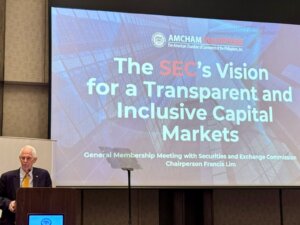
During his keynote at the American Chamber of Commerce of the Philippines (AmCham) GMM on October 15, 2025, Chairman Lim laid out the SEC’s vision: a capital market that attracts investments and empowers Filipinos—from small entrepreneurs to future investors—to participate in national growth.
Governance and Transparency: The Cornerstones of Trust
Chairman Lim opened his address by reaffirming the Philippines’ enduring economic partnership with the United States. This relationship, built on shared values of openness, innovation, and trust, continues to shape investor sentiment.
He emphasized that the SEC’s mission is not just to attract capital, but to ensure it stays. Strong governance, credible institutions, and transparent regulation are key to achieving this.
To deliver on that promise, the SEC has implemented internal reforms. Application timelines are now standardized: 3, 7, or 20 working days, depending on complexity. Under the “deemed approved” policy, requests are automatically approved if no action is taken within the set timeframe. Fees for document requests have been cut by 50%, and incorporation fees for small businesses have been reduced by 20%. These changes reflect a commitment to efficiency and fairness.
Empowering MSMEs and Expanding Access to Capital
Micro, small, and medium enterprises (MSMEs) drive much of the country’s employment and innovation. The SEC has made it easier for them to raise funds and formalize operations. Since June, MSMEs have received a 50% discount on capital-raising activities, lowering the cost of accessing the stock market.
Shelf registrations now remain valid for five years instead of three, giving companies more flexibility to raise capital when market conditions improve. The SEC also expanded its online registration platform, OneSEC, to include firms with foreign investors. Processing time has dropped dramatically—from weeks or months to as little as one day.
These initiatives are designed to show MSMEs that regulation can be an enabler, not a barrier. Programs like SEC Partners and Supply Chain Financing offer suppliers and small enterprises new pathways to working capital.
 Financial Literacy: A Long-Term Investment in Market Trust
Beyond structural reforms, the SEC is tackling one of the most overlooked challenges in market development: financial literacy. Chairman Lim noted that many Filipinos, including professionals, lack a basic understanding of capital markets. This knowledge gap leaves them vulnerable to scams and poor investment decisions.
To address this, the SEC is working with schools, NGOs, and private organizations to promote financial education. The goal is to make it a mandatory high school subject. Chairman Lim believes that long-term investor confidence depends on a financially literate population—one that understands how savings, investments, and retirement planning contribute to personal and national prosperity.
This initiative also supports the SEC’s broader campaign against financial fraud, illegal lending, and investment scams. These efforts are backed by stronger enforcement and collaboration with the Bangko Sentral ng Pilipinas (BSP) and other regulators.
Adaptive Regulation: Making Laws Work for Growth
Chairman Lim made it clear: regulation should enable—not disrupt—growth. Guided by this principle, the SEC is modernizing key financial laws to better serve their original purpose.
One example is the Personal Equity and Retirement Account (PERA) Law, the Philippine counterpart to the U.S. 401(k) system. It allows employees to invest in long-term retirement funds through the capital market. The SEC’s revisions ensure that PERA fulfills its promise of secure, flexible retirement savings.
The Commission is also updating the Implementing Rules and Regulations of the Real Estate Investment Trust (REIT) Act. These amendments aim to expand participation in the REIT sector and deepen the country’s capital markets.
Driving Market Innovation: GDRs and Tokenization
As global finance becomes increasingly digital, the SEC is preparing for the future. It is developing Global Depositary Receipt (GDR) mechanisms to attract more foreign investors to the Philippine stock market. This move will increase liquidity, diversity, and global competitiveness.
The SEC has also launched a regulatory sandbox to test financial technologies such as AI-driven finance and tokenization. These tools promise secure, transparent, and efficient digital transactions. Through these innovations, the SEC is ensuring that investor protection evolves alongside the financial system. 
A Shared Responsibility for Market Confidence
Chairman Lim closed his address with a reminder: investor confidence cannot be built by regulators alone. It requires collective commitment across sectors. The private sector must uphold ethical practices, promote transparency, and share insights that help regulators craft effective, market-responsive policies.
“When regulators and the private sector move together,” he said, “we create a virtuous cycle of trust, innovation, and growth.”
The ultimate goal is clear—to make the Philippines a trusted investment destination. A place where investors can say with confidence, “We know the rules, we trust the regulator, and we believe in the Philippines.”
Five Key Takeaways
- Investor trust is essential. Transparency and governance drive sustainable economic growth.
- Ease of doing business through faster, cheaper, and digitalized processes builds competitiveness.
- Financial literacy is a long-term investment in national resilience and investor protection.
- Support for MSMEs promotes inclusive growth and broadens participation in the capital market.
- Innovation with regulation—balancing technological advancement with strong oversight—is key to the future of finance.
Grow with the Philippine Capital Market
The SEC’s reforms are unlocking new opportunities for professionals and businesses. John Clements Consultants connects talent with organizations, helping drive this growth.
Contact us to take your next step today.

