

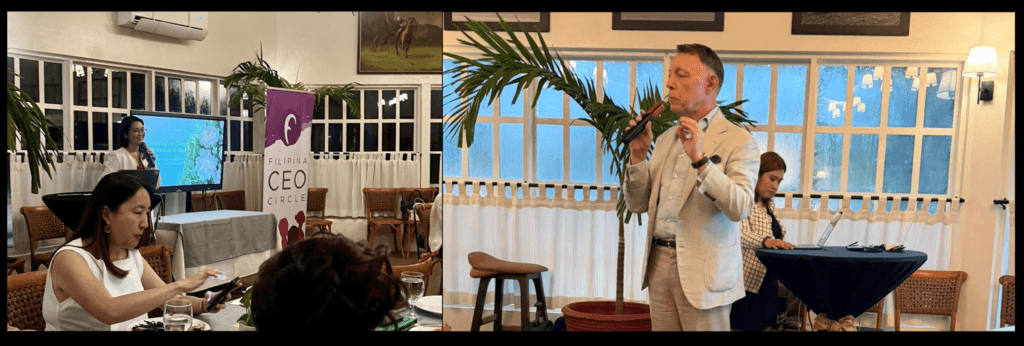
Reflections from the Filipina CEO Circle session with Jörg Dietzel
We often think of branding as a company’s job: a name, a logo, a campaign, a promise to customers. But one idea from the recent Filipina CEO Circle session with branding expert Jörg Dietzel cut through that assumption. It was simple, and it was personal: everyone already has a personal brand.
The question isn’t whether we have one. The question is whether we’re shaping it on purpose.
We form our personal brand every day. We form it in the way we show up to a meeting, write an email, introduce a colleague, respond under pressure, follow through on a commitment, or make someone feel heard. It lives in the expectations people carry before they meet us, and in the memory they keep afterward. Personal branding, in other words, isn’t about inventing a persona. It’s about revealing who we really are, then reinforcing that truth through consistent action.
Why personal branding matters now
The case for building your brand on purpose has gotten stronger, because work itself has changed. Careers no longer unfold inside one company for decades. Industries evolve or disappear. Artificial intelligence is reshaping tasks and roles. Remote and hybrid work strip away the informal visibility that office life used to create. And increasingly, people meet us online before they meet us in person.
None of this means we need to become influencers. It means we need clarity about the story our professional presence tells. In a volatile, uncertain, complex, and ambiguous environment, a clear personal brand offers something rare: continuity. It helps colleagues, clients, partners, and communities understand what we stand for, what we bring, and whether they can trust us. According to Edelman’s 2026 Trust Barometer, that kind of continuity matters more than ever, as public trust in institutions continues to erode worldwide.
A brand is more than an image
One useful distinction from the session: branding isn’t just a collection of visuals or communication tactics. It’s a decision about positioning. A corporate brand rests on purpose, positioning, values, customer experience, promise, and consistency. A personal brand rests on the same foundation.
| Corporate brand | Personal brand |
| Purpose | Purpose |
| Positioning | Positioning |
| Values | Behavior |
| Customer experience | Reputation |
| Promise | Consistency |
| Consistency | Trust |
Other people, not our own self-description, shape our professional reputation. We can’t fully control their perception, but we can influence it through clarity, credibility, and consistency. That takes alignment. When our stated values, our public profile, our conduct, our leadership style, and our follow-through tell conflicting stories, people notice, and trust weakens wherever message and behavior stop matching. Harvard Business School researcher Jill Avery makes a similar point in her overview of personal branding: the goal isn’t just visibility; it’s making sure the narrative about you matches reality.
The personal brand framework
Dietzel offered a practical five-part framework for thinking through personal brand.
Who
Who are you beyond your job title, employer, or business card? This is the foundation. A role can change. A company can change. A career can evolve. But the person underneath should keep a recognizable core, one rooted in something real: temperament, strengths, values, perspective, and lived experience.
Why
What drives you? This covers your values, beliefs, motivation, and sense of purpose. Why do you care about the work you do? Whom do you want to help? For many leaders, purpose isn’t a grand slogan — it’s a pattern, an enduring commitment to developing people, building institutions, creating opportunities, or solving hard problems.
What
How
How do people experience you? This is the daily reality of the brand. Are you reliable, strategic, calm, creative, generous, direct, thoughtful, or collaborative? Do you keep your promises? Do you make difficult matters easier to understand? People should leave interactions with you feeling clearer, supported, challenged, or energized — that felt experience is your brand, not any slogan you might write for it.
Try this exercise: pick three words you want people to associate with you. Then ask a few trusted colleagues or friends for the three words they’d actually use. The gap between the two lists often reveals real blind spots, along with real opportunities to grow.
Where
Where should people encounter you? Visibility should follow clarity, not replace it. Once we know who we are, what we stand for, and how we want to contribute, we can choose the right channels: LinkedIn, speaking, writing, mentoring, teaching, professional networks, leadership roles, or community work. The goal isn’t to be everywhere. It’s to show up meaningfully, and consistently, where the people we want to serve can encounter our ideas and our contribution.
Trust is the real currency
The most enduring point from the discussion: trust ultimately builds personal brands, not polish. A great profile alone can’t create trust. Behavior creates it — consistency, reliability, keeping promises, helping others, collaborating well, walking the talk, and being remembered for solving problems.
The session offered a simple reputation equation that captures this well: visibility gets attention, credibility earns trust, and consistency keeps it. Visibility might open the door, but credibility decides whether people listen. Consistency decides whether they come back. Research from the Harvard Business Review’s personal branding collection echoes this: authenticity and follow-through outperform self-promotion over the long run, every time.
This matters especially now, in a moment when many institutions are struggling to keep public trust. A personal brand can never substitute for substance. But leaders who stay clear, credible, and consistent can help rebuild confidence — one relationship, one promise, at a time.
Standing out while fitting in
A strong personal brand requires a delicate balance. We want to stand out, but not as a performance. At the same time, we want to fit into our organization, industry, or community, without disappearing into conformity.
Ultimately, the aim is to be both relevant and different, recognizable for something real, valuable, and authentic. However, that doesn’t require getting louder or more self-promotional. Rather, it requires becoming more intentional: having the courage to name what matters to us, the discipline to act on it, and the openness to understand how others actually experience us.
Moreover, no one builds a personal brand alone. Trusted friends, colleagues, mentors, and experts can help us see patterns we might otherwise miss. And even when their feedback stings a little, the truth remains a friend.
Two questions to carry forward
The session closed with two questions worth revisiting often:
If someone described you after this meeting, what would you hope they’d say?
If someone Googled you tonight, what story would they discover?
These aren’t invitations to build an artificial image. They’re invitations to close the gap between intention and perception. We devote enormous energy to building companies, teams, products, programs, and communities. Maybe it’s time we applied that same thoughtfulness to the most enduring asset we carry from one role, one organization, one chapter of life to the next: the brand called you.

