
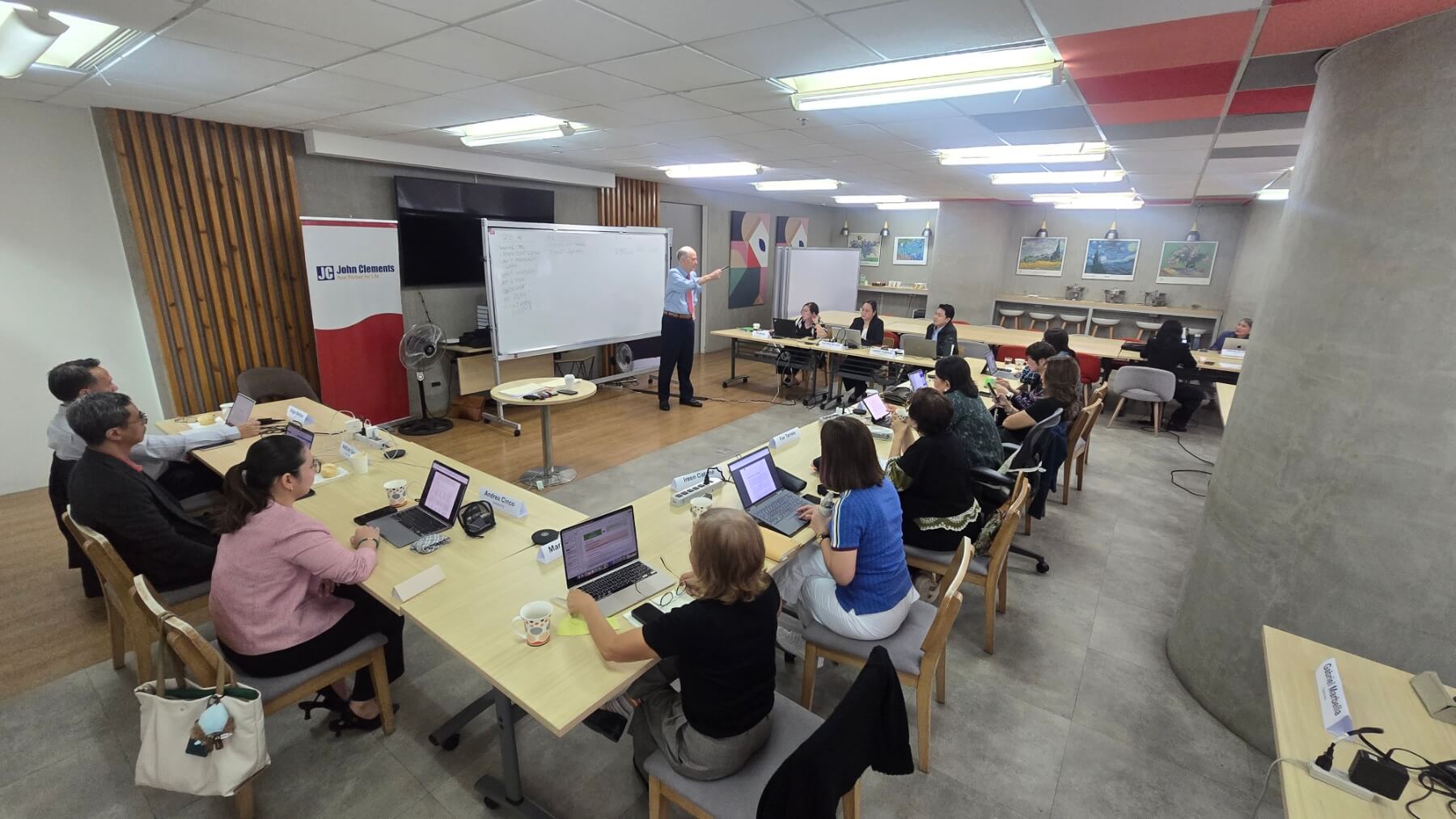
I believe learning never stops. That is why I value working at John Clements, a company that invests in workplace learning through its development programs. When I found out I would join a learning session on discussion leadership, focused on facilitating case studies, I felt both curious and nervous. By the end of the day, I was glad I had stepped out of my comfort zone. I also left with clear lessons on how to be a good discussion leader.
Setting the Stage: What Makes a Good Discussion Leader
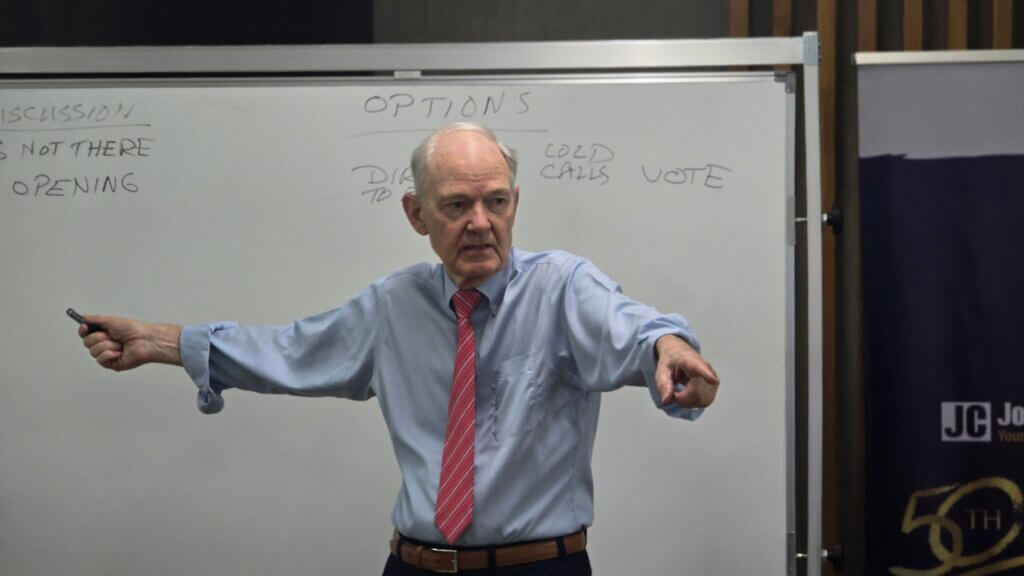
Tully Moss, an experienced coach, consultant, and facilitator of leadership development programs, led our session. He opened the day by welcoming participants and discussing our expectations. He then explained the Harvard-style case method, a discussion-based approach that Harvard Business School has used as its core teaching practice since the 1920s. Its 20/80 rule is simple: participants do 80 percent of the talking, while the facilitator does 20 percent.
Tully then called on participants at random, a technique known as cold calling. Done well, a cold call lays the groundwork for a strong discussion instead of putting someone on the spot. Tully also stressed that a facilitator should plan the first question carefully because it can steer the discussion in many directions. A strong opening question cannot be answered with a simple “yes” or “no.” It should move the class forward and spark deeper thinking.
Facilitators can also open with a polarizing question to spark debate, or a softball question that helps the class recap the case. Just as important is setting clear expectations, which Tully described as a contract between the facilitator and the participants. This idea echoes the teaching-learning contract explored in Education for Judgment: The Artistry of Discussion Leadership, a book co-edited by C. Roland Christensen, a pioneer of case method teaching at Harvard Business School.
Using a Blackboard Plan to Guide the Discussion
I especially enjoyed how we used whiteboards for notetaking, even though digital presentations were an option. I see whiteboards as shared notebooks where every idea gets acknowledged and every discussion grows richer.
Tully introduced the blackboard plan, which is how a facilitator organizes key information on the board from start to finish. In fact, most Harvard Business School teaching notes include blackboard plans that show how to organize participants’ comments. Still, no single formula exists for creating one. I always find it rewarding to watch the board fill up with insights from both the facilitator and the participants.
Tully also shared practical facilitation skills to help participants see new perspectives. A facilitator can play devil’s advocate to challenge the class, ask comparison-based questions, and invite participants to imagine how they would act in each situation.
Discussion Leadership Lessons from Case Studies
We first tackled a case about Jo Worthington, who struggled to lead a discussion with a disengaged class. Another case followed Ernie Budding, who faced a class whose dynamics shifted over time. Both cases taught us that subject matter expertise alone does not make a great teacher. A good discussion leader must also manage the classroom well.
Facilitators can build this skill by asking questions, seeking feedback from fellow educators, and learning directly from their students. These discussions reinforced one key idea: effective facilitation requires both content expertise and strong classroom management.
Putting Case Study Facilitation into Practice: The 1996 Mount Everest Case
Before lunch, Tully announced that we would apply our learnings to the 1996 Mount Everest case study, which Professor Michael Roberto wrote in 2003 as a member of the Harvard Business School faculty. Tully had shared the case in advance. At more than 22 pages, the case intimidated me at first, but I was eager to take on the challenge.
The case covers a real-life tragedy involving Rob Hall and Scott Fischer, leaders of two commercial Everest expeditions who both died on the mountain. It works well for case study facilitation because it offers many learning objectives, including decision-making, overconfidence, commitment to goals, communication breakdowns, and leadership dynamics. Roberto has even published a paper on how educators can use the Everest case to teach business leadership.
Tully divided us into four groups. Each group chose one representative to facilitate a discussion in front of the class and receive a whiteboard for its board plan.
I felt nervous because I would be facilitating for my group. Fortunately, my supportive groupmates guided and encouraged me throughout our preparation. One lesson that truly resonated with me was the value of a core learning objective, since it defines the scope of the discussion. I suggested we focus on the leadership styles of Rob Hall and Scott Fischer, and the group agreed. Gathering my courage, I volunteered to present first.
Stepping Out of My Comfort Zone as a Discussion Leader
I split the whiteboard into two sections, each with a statement that reflected the personality of one expedition leader. I asked participants to close their eyes as I read the statements aloud. Then I asked them to open their eyes and choose which leader they would follow.
I did my best to hide my nerves. I asked participants why they chose one leader over the other and encouraged them to discuss what the two leaders had in common. Eventually, Tully paused the discussion so the class could give feedback on my facilitation.
I was grateful to receive positive comments. The other groups then took their turns, exploring objectives such as decision-making under uncertainty and mismanagement. Putting our learnings to the test showed us firsthand how challenging facilitation can be. It also showed us how fulfilling it feels to engage participants and draw out diverse perspectives.
Final Reflections on How to Be a Good Discussion Leader
As the session ended, I realized how vital it is to know your material and guide your participants well. A good facilitator avoids being overly controlling. Instead, they create an environment where participants can reach the answers themselves.
“The art of teaching is the art of assisting discovery.” – Mark Van Doren
Stepping into the role of discussion leader felt both intimidating and rewarding. Most importantly, it taught me that effective facilitation is not about having all the answers. It is about asking the right questions, listening actively, and creating space for meaningful learning.
Quick Tips: How to Be a Good Discussion Leader
- Plan your opening question carefully and avoid yes-or-no questions.
- Set clear expectations with participants from the start.
- Use a blackboard plan to capture and connect ideas.
- Define one core learning objective to keep the discussion focused.
- Let participants do most of the talking, following the 20/80 rule.
- Challenge thinking by playing devil’s advocate or asking comparison questions.
Take Your Leadership to the Next Level
Continuous learning and strong leadership development drive impact across any organization. If you want to equip your team with world-class facilitation skills, leadership training, and workforce development solutions, discover how John Clements Consultants can support your organization’s growth.
Contact John Clements Consultants today to explore our leadership development programs.

