
Service contracting is a vital tool for organizations seeking flexible, efficient, and specialized workforces. Yet with flexibility comes responsibility. Companies must understand where legitimate service contracting ends and prohibited labor‑only contracting begins, especially as Philippine labor regulations continue to evolve.
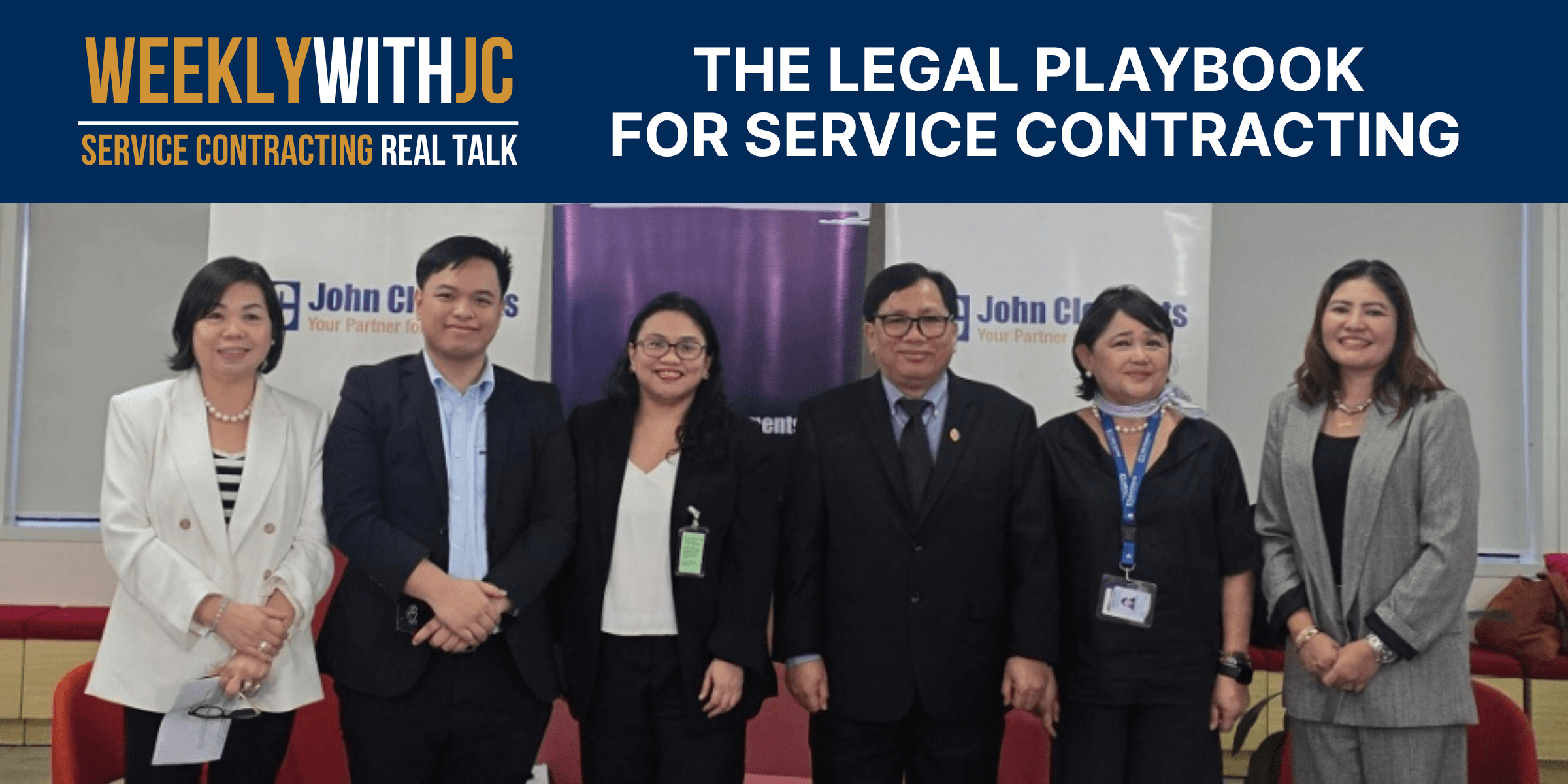
This was the central theme of the first of the #WeeklyWithJC Service Contracting Real Talk Series, entitled “The Legal Playbook for Service Contracting.” The session gathered legal experts and HR practitioners to discuss the realities of service contracting in the Philippines. Our speaker was Atty. Rashel Ann Pomoy (Senior Partner, V&A Law) with panelists Atty. Dave Umeran (Associate Lawyer, Magsalin Fernandez Quirolgico Law Office), Norman Gayloa (Senior Consultant, Junzi People Solutions), and moderator Ms. Tracy Piamonte (AVP, John Clements Consultants).
Understanding the Legal Line: Legitimate vs. Labor‑Only Contracting
Philippine labor law recognizes legitimate subcontracting. However, labor‑only contracting is prohibited. When an arrangement falls under labor‑only contracting, the principal may face serious consequences, including being considered the direct employer and becoming liable for wages and benefits.
Atty. Pomoy emphasized the importance of Department Order No. 174 (DO‑174), which governs contracting and subcontracting. Compliance must be built into the relationship from the start—not only when issues arise.
Key factors that influence legitimacy include:
- Who supervises the work
- Who provides tools and equipment
- Whether the contractor has sufficient resources
- How the contractor operates as an independent entity
Under DO‑174, the trilateral relationship involves three parties: the principal, the contractor, and the contractor’s employees. The contractor must remain an independent business entity responsible for employment obligations.
The Four‑Fold Test: Why Control Matters
The four‑fold test is a critical framework for assessing employment relationships. It considers:
- Selection and engagement of workers
- Payment of wages
- Power of dismissal
- Control over the means and methods of work
Control is the most telling factor. Even with a detailed service agreement, if the principal controls how contractors perform their work, the arrangement may face legal scrutiny. Clear boundaries, responsibilities, and reporting structures are essential.
Looking Beyond One Factor: Totality of Circumstances
Atty. Umeran highlighted that courts evaluate contracting arrangements based on the totality of circumstances, not just one factor. Organizations should ask:
- Who manages the workers?
- Who provides equipment?
- Who determines how the work is done?
- Is the contractor properly registered and capitalized?
From Compliance to Contractor Governance
Norman Gayloa emphasized the importance of contractor governance frameworks. Effective governance ensures accountability, compliance checkpoints, and proper documentation. Contracts, registration records, and periodic reviews provide evidence of compliance.
Regular alignment is crucial. As business needs and workforce expectations evolve, arrangements must be reviewed to avoid new risks.
Addressing Modern Workplace Realities
Today’s workforce introduces new challenges. Virtual and hybrid work can blur supervision lines, while Gen Z employees bring different expectations around flexibility, technology, and career growth.
Compliance must adapt to these realities. Strong governance should balance structure with flexibility, ensuring workforce arrangements remain compliant and sustainable.
Compliance as a Partnership
The most important takeaway: compliance is not just a legal requirement—it is a partnership. Successful service contracting requires transparency from the principal, accountability from the contractor, and continuous communication between both.
When boundaries are respected and rules understood, organizations can build workforce arrangements that are efficient, sustainable, and responsible.
The legal playbook therefore goes beyond knowing what the law says. It requires organizations to translate legal principles into everyday practices, monitor those practices consistently, and address risks before they become costly problems.
As businesses continue to embrace flexible workforce models, service contracting will remain an important part of the Philippine employment landscape. The challenge is to make flexibility work without compromising legal compliance, worker protection, or organizational accountability.
The insights shared during the #WeeklyWithJC Service Contracting Real Talk Series serve as a valuable reminder that responsible contracting is built on three foundations: knowledge, governance, and collaboration.
For organizations navigating the complexities of workforce solutions, having the right partner can make all the difference.
Continue Your Outsourcing Journey
Build compliant and sustainable workforce partnerships with John Clements Outsourcing. Learn more here: https://johnclements.com/client-solutions/outsourcing/

