
Three senior leaders get candid about bureaucracy, tech disruption, and the art of moving fast without breaking people.
Every organization eventually faces a moment when the very structure designed to keep things running begins to slow progress. Decisions stall. Emails pile up. Teams wait on approvals that should have been made last week. It’s a familiar frustration, and one that leaders are increasingly being asked to solve.
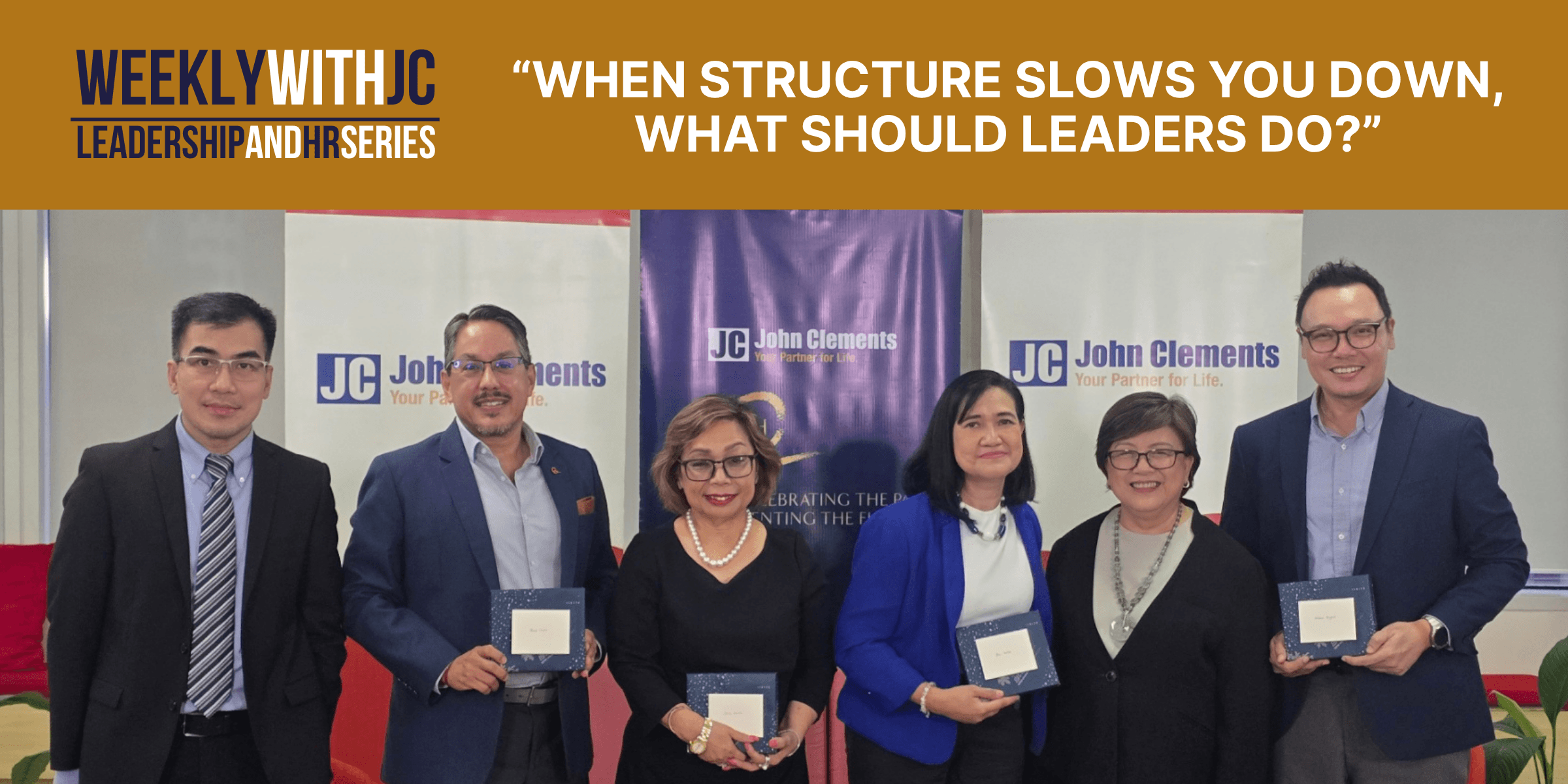
That was the focus of the June 25 session of the John Clements Leadership and HR Series: When Structure Slows You Down, What Should Leaders Do? Three seasoned HR and business leaders unpacked the realities of organizational drag and what it takes to move past it.
Employees Feel Problems First
Employees often sense dysfunction before leaders formally recognize it. Donna Grande, SVP, People at QBE Group Shared Services Centre and past president of PMAP, emphasized that employees absorb friction first.
Her advice was simple: go back to basics. Talk to people. Informal coffee sessions reveal root causes more effectively than surveys or town halls. Real conversations uncover what’s blocking the work.
Technology Changes Roles, Not Just Tools
Ellen C. Fullido, DPM and Vice President – HRAS at MBC Media Group, shared how MBC’s shift from traditional broadcasting to digital platforms transformed roles. Yesterday’s “DJ” is today’s “influencer.”
This evolution requires retraining, restructuring, and rethinking capabilities. Resistance often comes from management as well as staff. Buy‑in demands patience, deliberate communication, and comprehensive training programs that bring people along rather than leaving them behind.
Leaders Must Model Change
Mark Lwin, Managing Director of RELX | Reed Elsevier Philippines, highlighted that leaders must show, not just tell. His team built an AI agent to manage email, signaling that adopting new tools matters.
Artificial intelligence isn’t just disruption; it’s a prompt for intentional redesign. Organizations that embrace AI proactively will drive progressive change. Those that wait will have change imposed on them. This is where organizational change leadership becomes critical.
Change Management Is the Work
Mergers and acquisitions highlight structural clashes. Donna stressed that successful integration means identifying best practices from both organizations, guided by strategic rationale.
Creativity during change must be channeled, not suppressed. Programs like “10,000 bright ideas” encourage innovation within clear direction. Importantly, change experts must be involved from the start. Psychological safety ensures employees feel free to raise concerns and share ideas.
Measuring Success
Moderator Aldwin Gregorio asked how leaders measure progress. Mark pointed to revenue generation, while Donna emphasized employee ideas. Engagement signals investment in the future.
Failures occur when voices are excluded or downstream impacts ignored. Diagnostics must be holistic, considering leadership behavior, process quality, structural design, and culture together.
Key Takeaways
- Listen before you lead. Employees experience problems first.
- Adapt the role, not just the system. Transformation requires retraining.
- Your behavior is the message. Leaders must model change.
- Change management is a discipline. It must start early.
- Trust enables speed. Clear goals and trust drive accountability.
These lessons underscore the importance of organizational change leadership in navigating disruption.
What’s Next
If this conversation sparked something for you—whether it’s a structural challenge, a change initiative, or a talent need—John Clements Consultants can help.
We partner with organizations across industries to place leaders who move businesses forward. We also host events to keep the HR and leadership community connected, learning, and growing.
Explore our work and upcoming events at www.johnclements.com or reach out directly via our Contact Us page.
Let’s keep building organizations that move.

