
TL;DR
The Mid-Level Managers Program at John Clements Consultants uses real-world case studies—like Intel’s 2021 outsourcing dilemma—to build strategic, adaptive leaders. Key lessons: transparency prevents organizational failure, cultural alignment drives execution, and complacency is the enemy of competitiveness. These insights apply directly to complex, high-stakes environments like recruitment and talent management.
In the fast-paced world of semiconductor manufacturing, maintaining a competitive edge requires more than just technical competence. It demands strategic agility and a culture that embraces change.
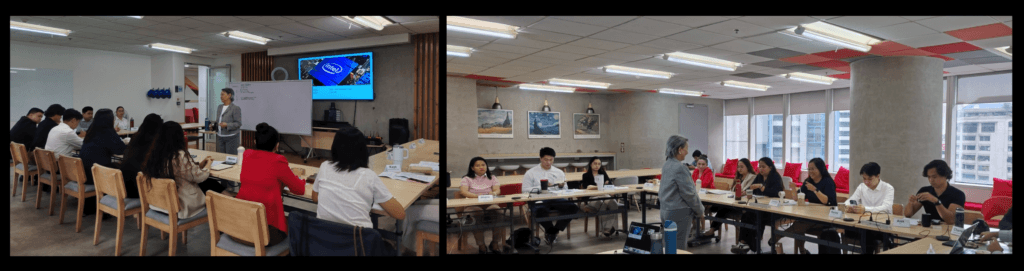
I recently attended the second session of the Midlevel Managers Program at John Clements Consultants, facilitated by Dr. Grace Alcid, the Learning and Development Director of the John Clements Leadership Institute. The session centered on a compelling case study regarding the “Outsourcing Dilemma” at Intel Corporation, providing insights into the challenges of leadership and organizational transformation.
The Intel Dilemma: Innovation at a Crossroads
Intel, long recognized as the titan of the semiconductor industry, faced a critical juncture in early 2021. Under the leadership of its newly appointed CEO, the company confronted a difficult choice: continue its tradition of vertical integration by manufacturing its own chips, or pivot toward an outsourcing strategy to address significant production delays.
For decades, Intel operated under a “copy exactly” strategy, believing that in-house manufacturing provided an unparalleled competitive advantage. However, this rigidity eventually became an obstacle. As rivals like AMD and NVIDIA shifted toward outsourcing manufacturing to specialized firms like the Taiwan Semiconductor Manufacturing Company (TSMC), they successfully focused on agile chip design. Intel, meanwhile, struggled with repeated manufacturing snags and internal cultural challenges that hindered its ability to adapt to a changing market.
The semiconductor sector is not alone in feeling this pressure. According to the World Economic Forum, organizations that fail to adapt their leadership pipelines to rapidly changing market conditions risk falling significantly behind competitors. Intel’s story is one of those cautionary examples.
Key Lessons from the Case
The discussion led by Dr. Grace Alcid highlighted that technical expertise is only part of the equation. One of the most striking insights from the Intel case was the impact of organizational culture on innovation—and the cost of ignoring geopolitical considerations. A previous CEO identified that Intel suffered from a culture where employees hesitated to share manufacturing issues with senior management. This significantly slowed problem-solving and contributed to shipment delays.
The session explored several vital leadership lessons:
- When internal silos prevent information from flowing, organizations lose their ability to react to competitive threats. Transparency is foundational.
- Even the most sophisticated technology roadmaps fail if the workforce feels discouraged or disconnected from the company’s strategic vision. Cultural alignment drives execution.
- Complacency can be fatal. Intel’s historical dominance in the PC market made it difficult for the firm to pivot quickly when the industry shifted toward smartphones and artificial intelligence. Avoid the “Monopoly Mindset”.
These dynamics are well-documented beyond the classroom. Research from McKinsey & Company consistently shows that organizational culture is one of the strongest predictors of whether a company successfully executes strategy—or fails trying.
TL; DR
Takeaway so far: Organizational culture isn’t a soft issue—it’s a strategic one. When employees are afraid to surface problems, leaders lose their most critical input: ground-level truth.
The Strategic Imperative for Midlevel Managers
For those of us in the Midlevel Managers Program, the Intel case serves as a reminder that management is about more than maintaining the status quo. It is about developing an environment where engineers and business strategists collaborate seamlessly.
The transition Jim Keller led—integrating design and manufacturing teams—proved that breaking down barriers can accelerate the development process by up to three times. This level of collaboration is essential when navigating complex international recruitment projects, where vendor accreditation and timely candidate placement require constant communication between diverse teams.
The ability to manage cross-functional complexity is increasingly cited as a top leadership competency. The Harvard Business Review identifies “collaborating and influencing” as among the most important competencies leaders around the world say are critical for navigating volatile, complex environments—precisely the kind of environments the Midlevel Managers Program prepares participants for.
Looking Forward: The Path to Adaptive Leadership
As we reflect on these insights, it becomes clear that leadership in the modern era requires a delicate balance. A company must honor its core competencies while remaining willing to disrupt its own processes to survive. Intel’s journey shows that the decision to outsource—or to stay vertically integrated—is never about cost. It is about strategic focus and organizational health.
The Midlevel Managers Program has equipped us with the analytical tools to dissect these complex dilemmas and apply them to our own business development and initiatives. Whether managing talent acquisition for specialized sectors or negotiating vendor fees, the ability to view challenges through a strategic lens is our greatest asset.
The stakes for getting leadership development right are high. According to the Association for Talent Development (ATD), organizations that invest consistently in leadership training outperform peers in productivity, retention, and profitability. Programs like the Midlevel Managers Program exist precisely to close that gap.
Why Middle Management Is the Backbone of Organizational Change
Middle managers often carry the most weight when organizations go through transformation. They translate executive strategy into team action. They absorb pressure from above and below. And yet, they are frequently underdeveloped as a leadership cohort.
Intel’s challenges were not simply failures of executive vision—they were also failures of the layers beneath. Midlevel leaders who were not empowered to surface problems became passive participants in a decline that took years to reverse.
The Deloitte Global Human Capital Trends report has flagged middle management empowerment as a recurring organizational priority. Companies that deliberately invest in this tier see faster change adoption, stronger team performance, and significantly better employee retention.
That is why structured programs like the Midlevel Managers Program matter. They are not just professional development opportunities—they are organizational investments.
TL; DR
Bottom line: Midlevel managers are the critical link between strategy and execution. Developing them is not optional—it is a competitive necessity. The John Clements Midlevel Managers Program builds exactly those capabilities.
Ready to Build Stronger Leaders?
The John Clements Leadership Institute’s Midlevel Managers Program is designed for organizations that want to develop strategically capable leaders—not just competent managers. Participants engage with real-world case studies, expert facilitators, and a cohort of peers navigating the same complex leadership challenges. Contact us now for more details.

