
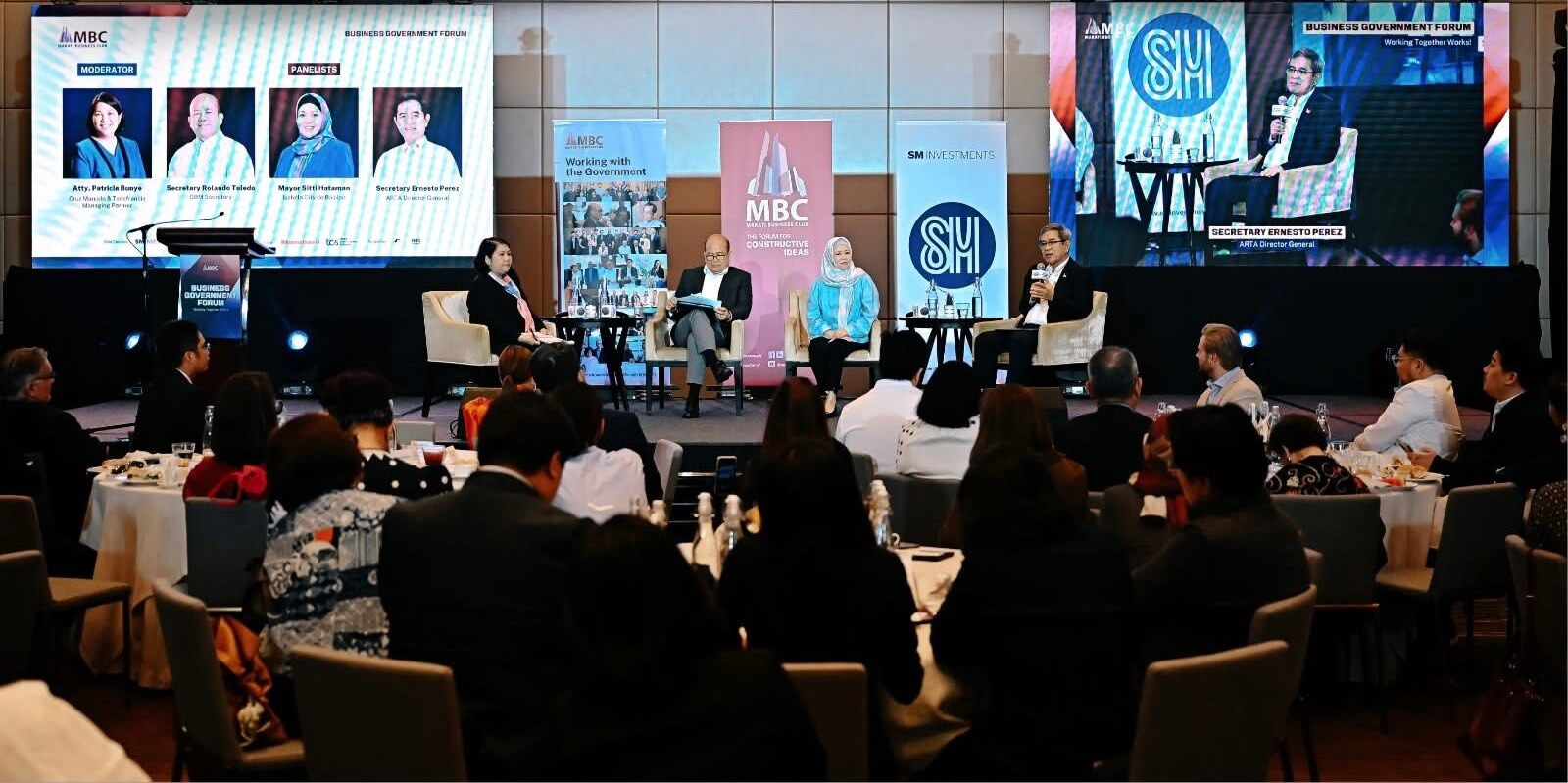
Last February 24, 2026, leaders from government, business, and civil society gathered at the New World Hotel in Makati City for the Makati Business Club (MBC) Business-Government Forum. More than a policy discussion, the afternoon became a candid exchange on how transparency reforms directly impact investment confidence, ease of doing business in the Philippines, and long-term economic resilience.
The forum, which capped MBC’s Government Dialogue Series, centered on a powerful theme: transparency is not just good governance—it is a sound economic strategy.

A Room United by Urgency and Opportunity
The atmosphere in the ballroom was both collaborative and urgent. Representatives from national agencies, local government units (LGUs), business chambers, and civil society groups filled the room. Consequently, there was a shared recognition that while the Philippines has strong laws on paper, implementation remains the critical test.
The panel featured:
- Rolando Toledo, Acting Secretary of the Department of Budget and Management (DBM)
- Ernesto V. Perez, Secretary of the Anti-Red Tape Authority (ARTA)
- Sitti Djalia Turabin-Hataman, Mayor of Isabela City
Moderated by Atty. Patricia Bunye, the discussion tackled institutional challenges, digital reforms, fiscal safeguards, and the evolving relationship between government and the private sector. Furthermore, a recurring message echoed throughout the session: predictability builds trust—and trust drives investment.
From Policy to Practice: The National Perspective
Secretary Toledo offered a candid look at the institutional challenges within government systems. He acknowledged issues such as delayed agency reporting, siloed digital platforms, and interoperability gaps between planning and budgeting systems.

However, he emphasized that DBM is actively addressing these gaps through:
- The Integrated Financial Management Information System (IFMIS) under the Public Financial Management Roadmap (2024–2028).
- Project DIME (Digital Information for Monitoring and Evaluation), which uses geotagging and digital monitoring tools to track infrastructure projects.
- Stronger certification requirements before the release of funds to ensure the legitimacy of projects.
One particularly striking moment occurred when he highlighted efforts to require agencies to publish proposed budgets even before submission to DBM—an early disclosure measure aimed at deepening transparency. For business leaders in the room, this move toward proactive disclosure signals improved fiscal predictability, which is an essential ingredient for investment planning.
Streamlining Government: ARTA’s Digital Push
Secretary Perez focused on embedding transparency directly into government processes. Rather than treating transparency as a compliance requirement, ARTA is institutionalizing it through digital reform.
Among the key initiatives discussed:
- The Electronic Business One-Stop Shop (eBOSS) system for LGUs.
- Reduced permitting timelines for telecommunications infrastructure under Executive Order 32.
- The Philippine Business Regulations Information System (PBRIS), which enhances transparency in rulemaking.
- AI-assisted tools that provide 24/7 access to Citizen’s Charters.
Perez noted that while progress has been made, only a fraction of the country’s 1,642 LGUs have fully implemented eBOSS. During the Q&A, this triggered a direct question from the audience: without enforcement mechanisms, how can compliance be accelerated? The exchange highlighted a real tension in reform implementation—balancing collaboration with accountability. Perez acknowledged that enforcement remains part of ARTA’s mandate but emphasized that partnership with the Makati Business Club and other business chambers is equally critical. Therefore, regulatory reform is most effective when government and business move in alignment.
A Local Government Success Story: Isabela City
Perhaps the most inspiring segment of the forum came from Mayor Sitti Djalia Turabin-Hataman. She openly admitted that the biggest challenge in reforming local governance was not technical—it was cultural. Changing mindsets about transparency required community education, institutional discipline, and leadership by example.
Under her administration, Isabela City achieved:
- ISO certification.
- Consistent recognition in the Cities and Municipalities Competitiveness Index.
- 31% business growth (2020–2024).
- 96% investment growth.
- A significant reduction in poverty incidence.
One highlight she shared was the annual “People’s Budget” process, where citizens review and provide feedback on fiscal plans before finalization. This participatory model transforms transparency from a document requirement into a lived civic practice. Because of this, her message resonated strongly: all economic growth is local. If reforms work at the LGU level, national competitiveness follows.
The Civil Society Lens: Transparency as Protection
The forum also featured remarks from civil society representatives, underscoring that corruption disproportionately impacts vulnerable communities. The call to action was clear: strengthen monitoring, increase beneficial ownership transparency, modernize procurement, and encourage citizen participation across the entire budget cycle—from preparation to execution. This broadened the conversation beyond the ease of doing business to something deeper: safeguarding public trust.
Key Insights from the Event
Reflecting on the discussions, several themes stand out:
- Digitalization is no longer optional—it is central to transparency reform.
- Laws alone are insufficient, implementation capacity matters more.
- Private sector collaboration via groups like the Makati Business Club accelerates reform effectiveness.
- Local governments are critical drivers of national competitiveness.
- Institutionalization of reforms is essential for sustainability across administrations.
The forum reinforced that improving the Philippines’ investment climate is not solely about tax incentives or infrastructure spending—it is about governance credibility.
Why This Matters for Business Leaders
For executives, investors, and entrepreneurs, the implications are clear:
- Transparent budgeting improves fiscal predictability.
- Streamlined permitting reduces operational risk.
- Digital platforms lower compliance costs.
- Public-private collaboration strengthens regulatory clarity.
The Philippines’ path toward upper-middle-income status depends on strengthening these foundations.
Working Together Works
As the forum concluded, one message lingered: transparency builds confidence, and confidence fuels growth. The dialogue at the Makati Business Club demonstrated that cross-sector collaboration is not theoretical—it is actively shaping reforms in budgeting, regulation, and local governance.
Sustaining momentum now requires institutionalizing gains, empowering citizens, and maintaining consistent engagement between government and business. Transparency, when embedded in systems and culture, becomes more than a governance principle—it becomes a competitive advantage.
Stay Ahead of the Industry
Want to stay updated on the latest business trends, leadership insights, and economic reforms in the Philippines?
👉 Follow John Clements Consultants on LinkedIn and Facebook for the latest industry happenings!


