
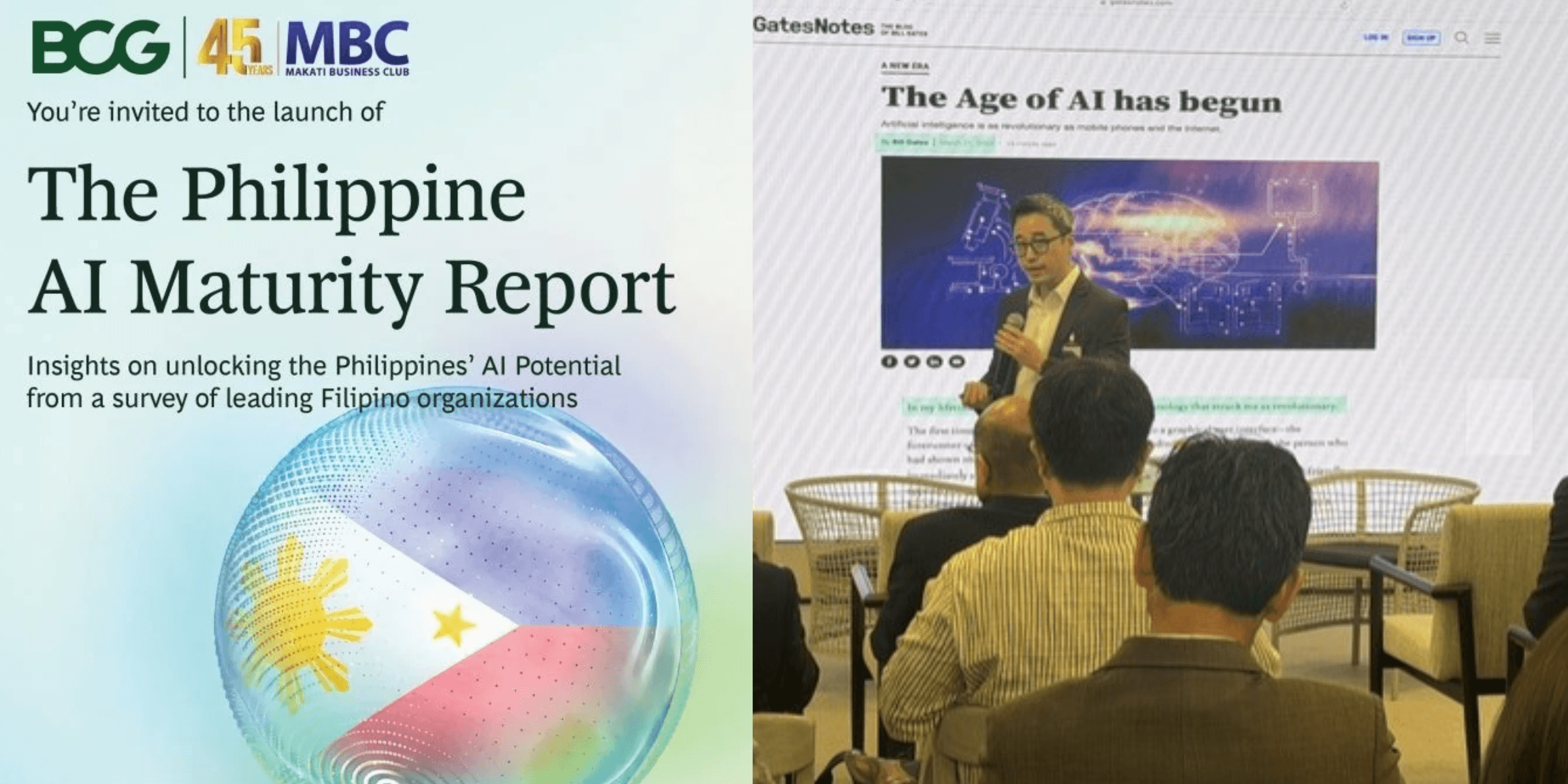
The report delivers a clear message: Filipinos have embraced artificial intelligence faster than many businesses have learned to use it effectively. While 81% of Filipino consumers had already interacted with an AI-powered service by May 2026, many organizations still struggle to convert AI adoption into measurable business value. Specifically, the challenge is no longer whether companies will adopt AI, but whether they can use it to drive productivity, innovation, and long-term growth.


The Philippines Stands at a Critical Turning Point
For decades, the Philippine economy has relied on its competitive labor-cost advantage, particularly through overseas Filipino workers and the IT-BPM industry. According to the report:
- Overseas Filipino worker remittances reached approximately US$42 billion in 2025.
- The IT-BPM industry generated around US$40 billion in export revenues.
- Together, these sectors contributed about 17% of the country’s GDP.
For additional economic data, visit:
However, AI now performs many routine tasks in customer service, finance, accounting, documentation, software development, and digital content creation. These are areas that have traditionally supported the Philippine outsourcing industry.
Two Possible Futures
Scenario 1: AI Replaces Labor
Organizations automate existing tasks, reduce workforce requirements, and gradually weaken the country’s traditional labor-cost advantage.
Scenario 2: AI Enhances Filipino Talent
Organizations use AI to improve productivity while enabling employees to focus on higher-value work requiring judgment, creativity, innovation, and relationship-building.
In contrast, the second path offers greater long-term benefits. To remain competitive, the Philippines must move from competing primarily on cost to competing on capability.
Philippine Companies Show Ambition but Need Better Execution
The Philippine AI report estimates that local companies remain roughly two years behind the global AI maturity curve. Although many organizations have begun their AI journey, none have yet reached the highest level of AI maturity. At the same time, many aim to achieve that milestone by 2029.
AI Maturity Scores
| AI Maturity Dimension | Score |
|---|---|
| Technology | 49 |
| Data | 48 |
| Operating Model | 45 |
| People | 43 |
| Strategy | 42 |
| Innovation | 39 |
| Operations | 38 |
| Customer Experience | 36 |
The findings reveal two distinct categories:
AI Enablers (Average Score: 46)
- Technology (49)
- Data (48)
- Operating Model (45)
- People (43)
Business Outcomes (Average Score: 37)
- Innovation (39)
- Operations (38)
- Customer Experience (36)
Consequently, the report identifies a nine-point gap between building AI capabilities and using those capabilities to produce business results. Many companies have invested in infrastructure, but fewer have successfully transformed products, services, or customer experiences through AI.
Three Major Barriers to AI Adoption
The Philippine AI report identifies three structural challenges that continue to slow AI transformation.
Data Infrastructure
Despite growing cloud adoption, many organizations still operate with fragmented systems and disconnected databases. Furthermore, only 57% have formal AI-specific data governance policies in place.
Talent Availability
Demand for AI talent continues to rise. However, only 17% of organizations believe they can recruit and retain enough AI-skilled professionals. Retention remains just as important as training.
Cost and Return on Investment
Philippine companies often pay near-global prices for cloud platforms, AI models, and related technologies. As usage grows, expenses increase as well. Therefore, leaders must evaluate AI investments carefully and focus on measurable returns.
Where Businesses Should Focus Their AI Investments
Technology alone does not create transformation. Instead, organizations must align people, processes, and strategy with AI initiatives.
Globally, companies invest four to five times more in non-IT AI initiatives than in technology infrastructure alone. These investments include employee upskilling, business process redesign, governance, and change management.
Three Strategic Approaches
- Deploy
Integrate AI into existing tasks to improve efficiency and productivity. - Reshape
Redesign entire business processes around AI and potentially achieve 30% to 50% gains in efficiency and effectiveness. - Invent
Create new AI-powered products, services, and business models.
The greatest opportunities lie in reshaping workflows and creating new sources of value rather than simply automating individual activities.
Recommendations for Government and Business
According to the Philippine AI report, success requires coordinated action from both the public and private sectors.
Government Priorities
- Modernize digital infrastructure and improve interoperability.
- Expand advanced AI education and workforce development.
- Make AI technologies more accessible to businesses of all sizes.
For further information:
Priorities for Philippine Companies
- Develop a focused, multiyear AI strategy.
- Invest in high-impact use cases.
- Upskill employees and redesign roles.
- Improve data quality and governance.
- Manage AI costs carefully.
- Measure business outcomes while encouraging innovation.
Final Takeaway: The Time to Act Is Now
The Philippine AI report serves as both a warning and an opportunity. AI could reduce the country’s traditional cost advantage, but it could also help Filipino workers and businesses move up the value chain. The outcome depends on the decisions organizations make today.
The Philippines already possesses the talent, entrepreneurial energy, and global connections needed to succeed. What businesses need now is urgency, investment, leadership, and execution. The organizations that act early will be better positioned to compete in an increasingly AI-driven economy.

