
Artificial Intelligence (AI) is rapidly transforming the modern workplace, reshaping industries, redefining jobs, and challenging leaders to rethink how organizations operate. As businesses accelerate digital transformation, the need for ethical governance, employee trust, and human-centered leadership has never been more critical.
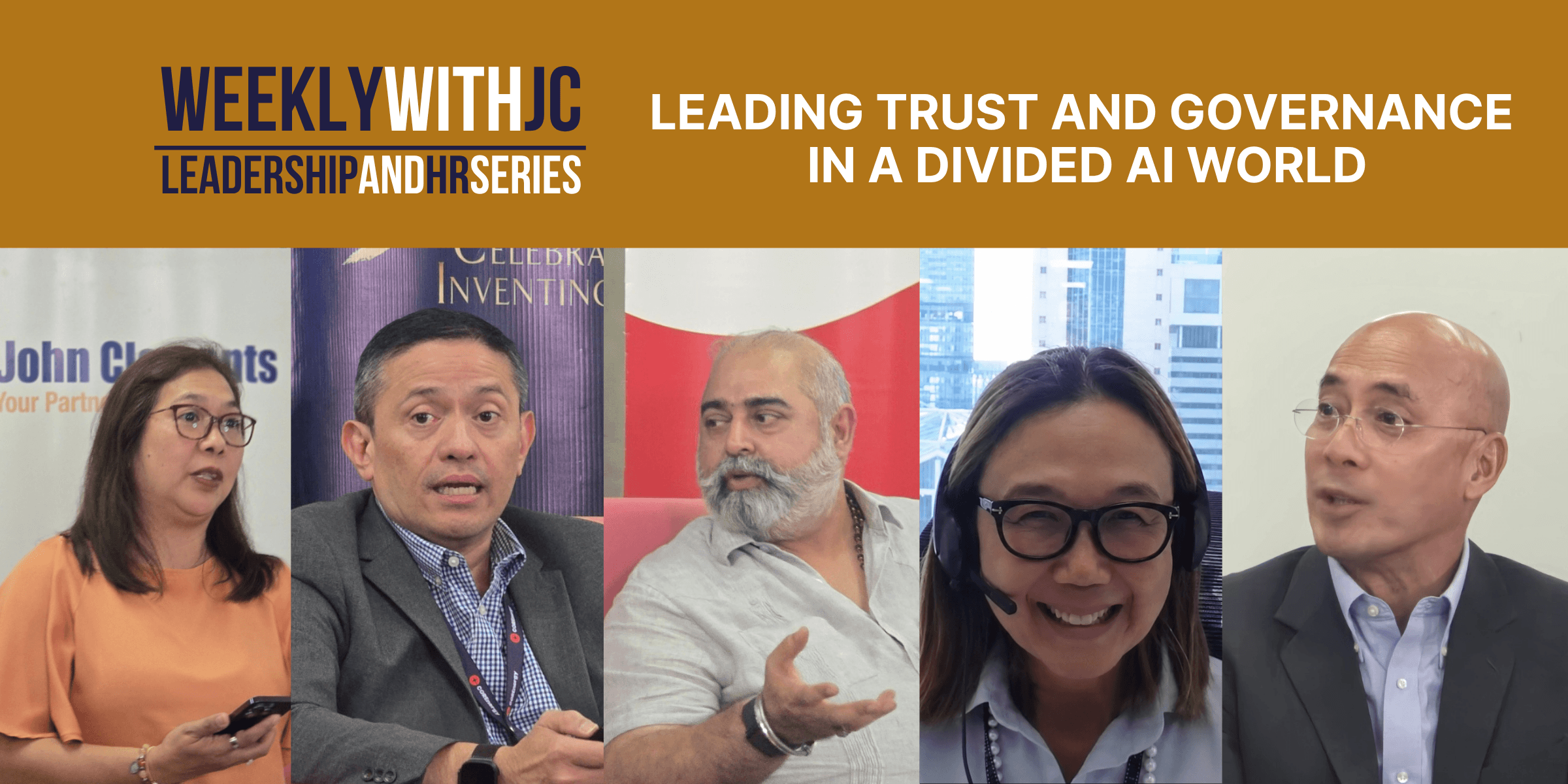
These timely discussions took center stage during the “Leadership and HR Series: Leading Trust and Governance in a Divided AI World,” where industry leaders and HR experts explored how organizations can successfully adopt AI while maintaining transparency, ethics, and employee confidence.
The event featured insights from respected business leaders Francis Del Val (President, COREnergy, Inc.), Jaideep Pradhan (SVP & Geography Head, EXL), Angelena Cala (Head of Human Resources, Dymon Asia Capital) who shared practical strategies on AI adoption, workforce transformation, leadership culture, and the future of work in the age of artificial intelligence with Gerboy Ortega (Consultant – HR/Business Change and Transformation, GT Ortega Leadership and Management Consultancy Services) as moderator.
AI Adoption is Becoming a Business Necessity
One of the key themes was clear: organizations can no longer afford to ignore AI.
Businesses that fail to embrace artificial intelligence risk losing competitiveness, operational efficiency, and long-term growth opportunities. According to the panelists, AI is now driving innovation across industries such as IT-BPO, finance, customer service, analytics, and consulting — particularly in Southeast Asia, where digital transformation continues to accelerate (Philippine Statistics Authority).
Francis Del Val shared his experience working with data science and machine learning as early as 2016. He explained how AI has significantly improved productivity by automating tasks that previously required weeks or even months.
From AI-assisted consulting reports and automated presentations to advanced analytics and geospatial intelligence, organizations are increasingly leveraging AI to improve decision-making, streamline workflows, and enhance customer experiences. Consequently, AI is no longer simply a technology trend — it is becoming a strategic business advantage.
Why Human-Centered Leadership Matters in the AI Era
While AI offers opportunities, successful transformation is ultimately about people.
One of the biggest challenges organizations face is employee fear and resistance. Many workers worry that AI could replace jobs, reduce opportunities, or make certain skills obsolete.
Francis Del Val explained that fear often stems from uncertainty and poor communication. When leaders fail to clearly explain how AI will impact employees, people naturally assume the worst.
This is where HR leaders and executives play a crucial role. Specifically, organizations must communicate the value of AI and how it supports employees in their daily work. The goal is not to replace people, but to remove repetitive tasks so employees can focus on strategic thinking, creativity, innovation, and relationship-building.
Angelena Cala reinforced this perspective by emphasizing the importance of prioritizing human connection in an increasingly digital workplace. According to her, AI can improve speed and efficiency, but it cannot replace empathy, emotional intelligence, coaching, and authentic leadership.
Key Takeaways from the Leadership and HR Series
- Clear Communication Builds Employee Trust
Organizations must continuously educate employees about:
- Why AI is being introduced
- How AI will impact roles
- What new opportunities AI creates
- How the company supports development
Overcommunication is essential during organizational change because uncertainty often leads to fear and resistance.
- AI Should Enhance Human Capability
The panelists stressed that AI should support human decision-making — not replace human judgment. In industries such as healthcare, banking, and HR, human oversight remains critical (National Library of Medicine (ncbi.nlm.nih.gov in Bing)).
Maintaining a “human in the loop” approach ensures responsible use while protecting trust and decision quality.
- Workforce Reskilling is Critical
As AI reshapes jobs, companies must prioritize reskilling. Francis Del Val introduced the “Four R’s” framework:
- Redeploy
- Retool
- Retrain
- Redesign
Jaideep Pradhan shared how EXL is retraining thousands of employees to adapt to changing business needs in the AI era.
- Ethical AI Governance Protects Long-Term Trust
Ethics and governance were among the most important themes. Risks of irresponsible adoption include:
- Data privacy issues
- AI hallucinations
- Algorithmic bias
- Cybersecurity threats
- Over-automation
The panel agreed that organizations must prioritize ethical AI governance to maintain trust and sustainability (OECD AI Policy Observatory).
The Future of Work Must Remain Human
The “Leadership and HR Series” delivered an important message: AI is not just a technology conversation — it is a leadership, culture, and people conversation.
As artificial intelligence continues to transform the workplace, organizations that succeed will be those that combine innovation with empathy, automation with accountability, and productivity with trust.
The future of work may be powered by AI leadership, but it must remain deeply human.
Ready to strengthen your organization’s leadership in the AI era? Contact Us today to learn more.

