
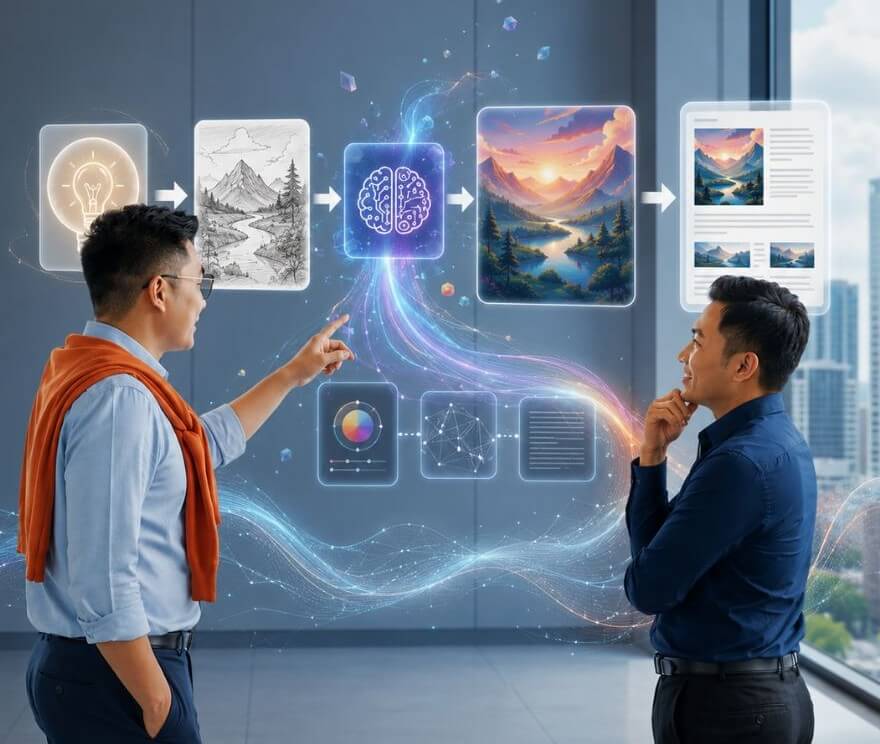
In today’s fast-moving digital world, creativity continues to evolve alongside technology. Tasks that once required hours of brainstorming, sketching, and revising can now be supported by AI-powered tools. Yet one truth remains clear: creativity still begins with human imagination. This balance defines the rise of AI creativity in modern workflows.
This idea became the core of the session titled “Break the Blank Page: How AI Unlocks Your Creative Potential.” The discussion explored how technology reshapes creative industries. More importantly, it emphasized that AI should not replace human creativity—it should strengthen it.
Learning to Think With AI
The session introduced participants to the fundamentals of AI and its practical applications. Facilitators encouraged bite-sized learning, hands-on experimentation, and real-world use cases. Consequently, participants were urged to think with AI instead of resisting it.
A key message stood out: curiosity unlocks opportunity.
Gerald “Gerds” emphasized continuous learning through:
- Experimenting with AI tools
- Testing new workflows
- Building real creative projects
In contrast to traditional learning, mastering AI now involves applying it across industries such as business, design, and content creation. As a result, AI creativity becomes a skill that grows through action, not theory.
AI as a Creative Partner, Not a Replacement
The session highlighted a powerful mindset:
Learn, Live, Build with AI
This framework encourages creators to integrate AI into their creative journey. AI can assist in:
- Generating ideas
- Structuring content
- Producing drafts
- Improving efficiency
However, human direction remains essential. One statement captured this perfectly:
“AI is a pilot, not an autopilot.”
AI can spot patterns and suggest ideas. Humans provide context, emotion, and judgment. Therefore, AI creativity thrives when both work together.
Transforming Visual Design Workflows
AI is becoming increasingly valuable in visual design and digital art. Today, creators can generate:
- Posters and branding materials
- Illustrations and concept art
- Marketing visuals
These tools allow faster iteration and greater experimentation. Specifically, creators can explore multiple directions at once instead of committing to a single concept early.
Gerald shared his journey from traditional design to AI-assisted workflows. Initially, he relied on manual techniques. Over time, he adapted. Not because AI replaced his skills, but because it enhanced them.
He stressed the importance of detailed prompts, including:
- Composition
- Lighting
- Camera angle
- Mood and style
The more specific the input, the better the output. This reinforces a key point: AI creativity still depends on human thinking.
Enhancing Writing and Emotional Expression
While design focuses on visuals, writing introduces emotion. This shift became evident during Gab’s discussion on poetry and storytelling.
He explained that creativity remains deeply tied to human experience. AI can assist with:
- Refining language
- Suggesting structure
- Improving clarity
However, emotion cannot be automated.
Gab reminded participants:
“If you don’t love the labor, you don’t love the art.”
This insight highlights a growing debate: originality versus convenience. While AI accelerates output, it cannot replace lived experience. Consequently, AI creativity works best when it enhances, rather than shortcuts, the creative process.
Key Takeaways for Creators
To effectively integrate AI into your workflow, consider the following:
- Stay curious and keep experimenting
- Use AI as a support tool, not a replacement
- Focus on clear and detailed prompts
- Maintain human judgment and creativity
- Balance efficiency with authenticity
These principles ensure that technology amplifies creativity instead of diminishing it.
Breaking the Blank Page for Good
Breaking the blank page no longer requires waiting for inspiration. With AI, creators can brainstorm faster, explore more ideas, and execute projects with greater efficiency. Still, technology alone is not enough.
Human imagination remains the driving force.
In the end, AI can generate outputs—but people create meaning. That is the true power behind AI creativity.
Take the Next Step
As AI continues to reshape industries, adapting your creative workflow becomes essential. Whether you’re building a team or exploring new capabilities, the right support makes a difference.
Connect with us today: https://www.johnclements.com/contact-us/

