
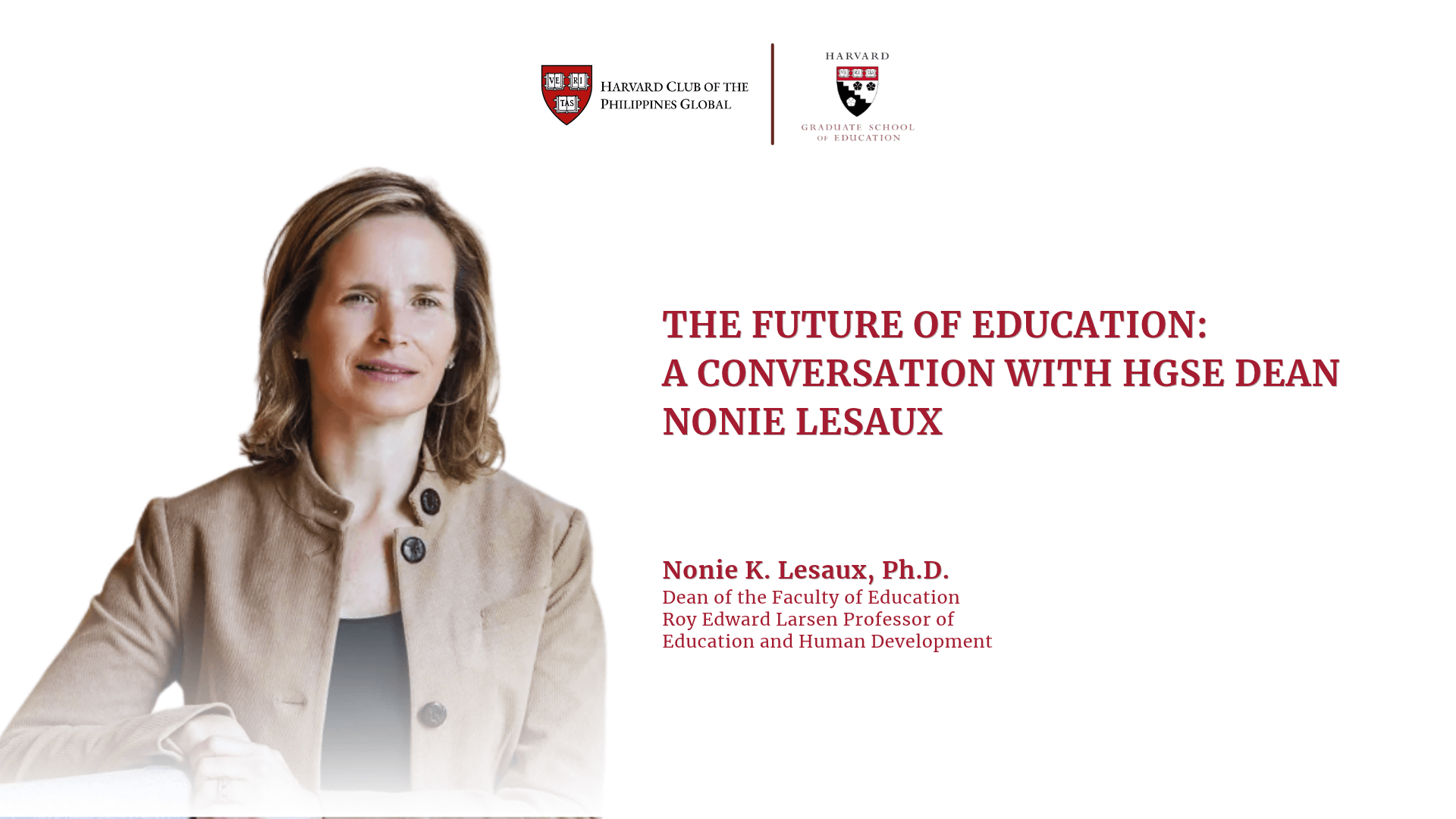
The rapid rise of artificial intelligence is transforming industries around the world, and education is no exception. I recently had the opportunity to assist at the Harvard Club of the Philippines Global event, The Future of Education: A Conversation with Harvard Graduate School of Education (HGSE) Dean Nonie K. Lesaux, Ph.D., held at Manila House Private Club in BGC, Taguig City.
The discussion explored how AI is reshaping learning and what educators, institutions, communities, and businesses must do to prepare learners for the future. One message resonated throughout the conversation: access to information is not the same as learning.


AI Creates an Opportunity to Rethink Education
Looking Beyond Technology Adoption
Dr. Lesaux encouraged participants to look beyond simply adopting new technologies. While AI offers unprecedented opportunities to address educational challenges and expand access to knowledge, its effectiveness depends on how thoughtfully it is used.
Technology alone cannot improve learning outcomes. Instead, meaningful progress requires an education-first approach supported by strong policies, professional development, workforce readiness, and collaboration across sectors.
Furthermore, institutions must redesign learning environments around the needs of learners rather than around technology itself. This is where human-centered learning becomes especially important. Technology should support learning goals, not become the goal.
Strengthening Human Capabilities
Enhance Thinking, Not Dependence
One of the discussion’s strongest takeaways focused on using AI to strengthen human abilities rather than create dependence.
AI can generate quick answers. However, learners still need opportunities to ask questions, evaluate information, solve problems, and exercise sound judgment. Education should continue developing:
- Critical thinking
- Creativity
- Curiosity
- Emotional regulation
- Empathy
- Ethical decision-making
Consequently, these skills become even more valuable as the future of work continues to evolve. Although no one can predict every future job or skill requirement, people can prepare for uncertainty through adaptable thinking and lifelong learning.
This shift requires educators and institutions to move beyond measuring information recall alone. Specifically, they must find meaningful ways to assess durable skills, active participation, and real-world application of knowledge.
Learning Goes Beyond Information
Human Connection Still Matters
Dr. Lesaux emphasized that learning involves much more than accessing content. Hands-on experiences, collaboration, discussion, and active participation help learners build deeper understanding.
She also pointed to early education as an effective model. Young children often learn through interactive and interdisciplinary experiences. In contrast, learning environments can become increasingly passive as students grow older.
The opportunity today is to bring greater engagement and connection back into education through human-centered learning approaches that encourage participation and collaboration.
Universities must evolve as well. Their future may include more flexible, interdisciplinary, and student-led experiences. Nevertheless, meaningful learning still depends on community, mentorship, and shared experiences.
Teachers Remain Essential in the AI Era
AI as a Support Tool
AI should empower educators rather than replace them. Teachers remain mentors, facilitators, decision-makers, and guides throughout the learning journey.
When implemented thoughtfully, AI can:
- Reduce administrative workloads
- Support data-informed instruction
- Increase time for student engagement
- Promote responsible and ethical technology use
As a result, educators can devote more attention to relationship-building and personalized instruction. These elements remain central to human-centered learning and cannot be replicated by technology alone.
However, successful adoption requires ongoing support. Educators need training, resources, and institutional guidance to integrate AI effectively into their teaching practices.
Equity Requires Collective Action
Closing Access Gaps
The discussion also highlighted a major challenge. While technology can create opportunity, it can also widen educational inequalities when access and readiness vary across communities.
For countries like the Philippines, addressing gaps in infrastructure and AI literacy requires coordinated action among multiple stakeholders. Government agencies, educational institutions, businesses, and community leaders all have important roles to play.
Organizations can support these efforts through initiatives aligned with national education priorities outlined by the Department of Education:
Furthermore, innovation must reach underserved communities if technology is to become a true driver of educational progress.
Dr. Lesaux also recognized the Philippines’ ongoing education reform efforts. Sustained progress depends on evidence-based planning, effective implementation, continuous monitoring, and ongoing improvement.
Moving Forward: Making Learning More Human
A Future Built Around People
The session reinforced a powerful principle: the future of education should not be measured by how much technology we adopt, but by how effectively we help people learn, grow, and thrive.
For organizations like John Clements, this perspective offers an important reminder to invest in lifelong learning, critical thinking, workforce readiness, and responsible AI adoption. These investments help prepare individuals for an evolving world of work while keeping human-centered learning at the heart of development.
Ultimately, the goal is not simply to create smarter technology. The goal is to use technology in ways that expand opportunity, strengthen communities, and advance human-centered learning for future generations.
Visit our Contact Us page to learn more about how John Clements helps individuals and organizations develop talent for the future.

