
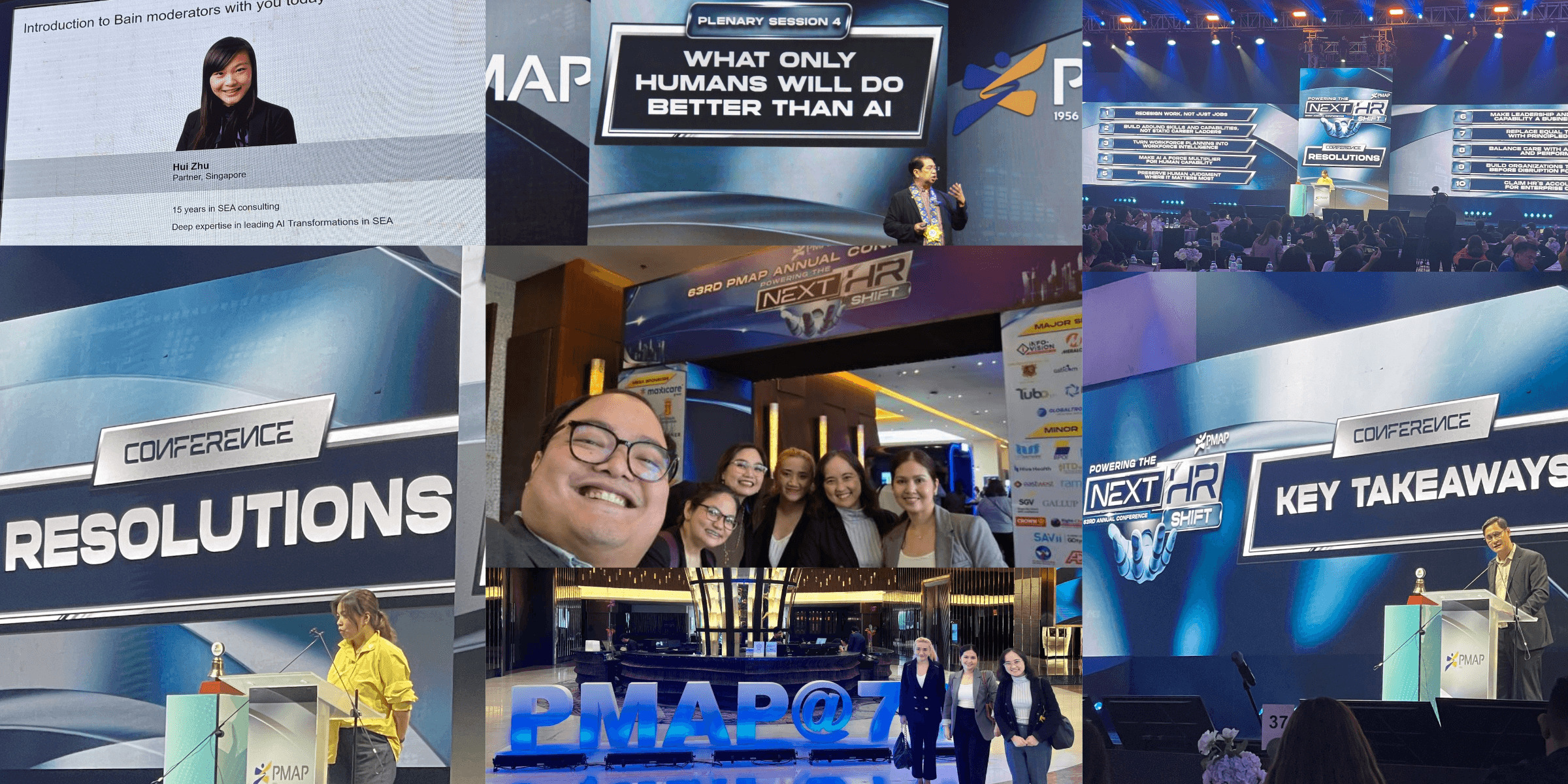
Through the day’s plenaries, learning sessions, and closing reflections, Phoebe, Cheska, Judy, Hazel, and DA gathered insights on building future-ready workforces, designing organizations around skills and capabilities, leveraging AI responsibly, and strengthening the leadership qualities that machines cannot replicate. Together, their takeaways highlighted a common theme: as organizations navigate rapid change, lasting success will belong to those that embrace innovation while investing in human potential, adaptability, and purpose-driven leadership.
Contributing Writers: Phoebe Porteza, Cheska Gardaya, Judy Ignacio, Hazel Tolentino, DA Adlus
For additional insights on workforce development and labor trends in the Philippines, readers may refer to:
Workforce Intelligence: Planning Beyond Headcount
From Workforce Planning to Workforce Intelligence
During the session From Workforce Planning to Workforce Intelligence: The AI Advantage, facilitated by Gina Yu and Ian Frederic Illagan of Bain & Company, Phoebe gained valuable insights into how organizations can prepare for a rapidly evolving world of work.
One of her key takeaways was that workforce planning must extend beyond filling vacancies and managing headcount. Instead, organizations should understand the skills, tasks, and capabilities required to create long-term value. The discussion emphasized that workforce intelligence complements traditional workforce planning by helping leaders identify future skill requirements, address capability gaps, and adapt roles as business needs evolve.
Building Future-Ready Organizations Through Human-AI Collaboration
Furthermore, Phoebe learned that adaptability and continuous learning are critical to workforce success. While AI delivers speed, efficiency, and scalability, people contribute creativity, empathy, critical thinking, ethical judgment, and strategic insight.
Consequently, organizations must invest in upskilling and reskilling while building cultures that support learning and innovation. Long-term success depends not only on filling positions but also on developing the capabilities needed for future growth.
Human Strengths in the Age of AI
Why Human Capabilities Still Matter
Drawing from the insights of Professor Alberto Mateo of the Asian Institute of Management, Cheska learned that the future of work is not a competition between humans and AI. Instead, it is a partnership that combines the strengths of both.
Using chess as an example, the session demonstrated that teams composed of humans and technology often outperform either one alone. While AI excels at processing information and automating repetitive work, people continue to provide the insight and perspective required for effective leadership.
The Four Human Capabilities AI Cannot Replace
A major takeaway from the session was the importance of strengthening four essential human qualities:
- Judgment
- Empathy
- Trust
- Courage
Although AI can generate recommendations and insights, people remain responsible for interpreting context, making ethical decisions, building relationships, and leading through uncertainty. Therefore, successful organizations will continue investing in human capabilities alongside technological advancement.
Building the Talent Bench for an AI-Powered Enterprise
Strategy Before Technology
During the session Building the Talent Bench for an AI-Powered Enterprise, facilitated by Hui Zhu of Bain & Company Singapore, Judy learned that AI transformation begins with strategy, not technology.
Organizations must align AI investments with business goals such as:
- Revenue growth
- Operational efficiency
- Customer experience improvement
- Innovation
The discussion highlighted three key enablers of transformation:
- Technology
- Data
- People
While technology and data provide the foundation, people remain central to achieving sustainable business results.
The Future of Recruitment and Workforce Readiness
Another key lesson involved developing future-ready talent strategies. Organizations must determine whether critical capabilities should be built internally, acquired through hiring, or supported through external partnerships.
Specifically, Judy noted the growing demand for specialized roles such as:
- Data Scientists
- Data Engineers
- AI Engineers
- AI Platform Engineers
As a result, recruitment is becoming a more strategic function that helps organizations anticipate skill needs, build talent pipelines, and support long-term workforce readiness.
Turning Conference Insights into Action
Building Organizations Around Skills and Capabilities
During the conference closing session, Hazel reflected on the insights shared by Luigi Mapa and the PMAP Humanity Manifesto presented by Jovie Ann Monsalud.
One of her strongest takeaways was that HR must move beyond managing jobs and processes and instead focus on shaping how organizations create value. Key themes included redesigning work, developing skills-based organizations, strengthening workforce intelligence, and leveraging AI to enhance human potential.
The PMAP Humanity Manifesto
The discussion highlighted several commitments for creating future-ready organizations, including:
- Designing work around skills and capabilities
- Developing stronger leadership pipelines
- Promoting fairness and accountability
- Strengthening workforce resilience
- Using AI responsibly
- Enhancing organizational adaptability
Moreover, Hazel learned that business performance and human dignity should not be treated as competing priorities. Instead, both should work together to create sustainable organizational success.
Leading With Humanity in the Age of AI
Technology Should Serve People
During another Day 3 session, DA gained valuable insights from Dr. John Stahl-Wert and Scott Friedman on the importance of preserving a people-centered approach in an increasingly digital workplace.
One of the strongest messages from both speakers was simple yet powerful: technology can improve efficiency, but it cannot replace empathy, trust, responsibility, and genuine human connection.
Dr. Stahl-Wert emphasized that effective leaders create environments where people can grow and succeed. He compared leadership to farming, where growth happens when the right conditions exist, not when results are forced.
Balancing Innovation With Human Connection
Scott Friedman reinforced this message through his GPA philosophy:
- Gratitude
- Play
- Surprise
The discussion also emphasized the importance of psychological safety. Employees must feel comfortable sharing ideas, asking questions, and learning from mistakes without fear of judgment.
Consequently, DA reflected that the future of work depends not only on adopting technology but also on strengthening the human qualities that technology cannot replicate. Recruitment, leadership, and employee engagement all require a balance between innovation and genuine care for people.
Key Day 3 Themes
Across all sessions, several consistent themes emerged:
Workforce Transformation
- Move from workforce planning to workforce intelligence
- Focus on capabilities rather than headcount alone
- Prioritize continuous reskilling and upskilling
Human-AI Collaboration
- Use AI to amplify human strengths
- Preserve human judgment in critical decisions
- Design work that combines technology and human expertise
Leadership and Culture
- Strengthen trust and psychological safety
- Build people-centered workplaces
- Develop leaders who can guide transformation
Talent and Recruitment
- Anticipate future skill requirements
- Build sustainable talent pipelines
- Align recruitment with long-term business goals
Looking Ahead
The lessons from the PMAP Annual Conference 2026 revealed that the future of work is not solely about adopting new technologies. It is about helping people adapt, learn, and thrive alongside those technologies.
As organizations navigate increasingly complex workforce challenges, the insights shared during the PMAP Annual Conference 2026 reinforce the importance of workforce intelligence, continuous learning, responsible AI adoption, and people-centered leadership. Furthermore, the discussions demonstrated that technology creates the greatest value when it supports human capability rather than replaces it.
The PMAP Annual Conference 2026 also highlighted the evolving role of HR as a strategic partner in workforce transformation. Whether through talent acquisition, capability development, leadership growth, or organizational design, HR professionals play a critical role in shaping future-ready organizations.
Ultimately, the message from the PMAP Annual Conference 2026 was clear: organizations that balance innovation with empathy, data with judgment, and technology with humanity will be best positioned for long-term success. As businesses continue to evolve, the insights from the PMAP Annual Conference 2026 provide a valuable roadmap for building workplaces where both people and performance can thrive.
Connect With John Clements
Looking to strengthen your talent strategy, leadership pipeline, or workforce readiness initiatives? John Clements can help your organization navigate the evolving future of work through expert recruitment, HR consulting, and workforce solutions.

