
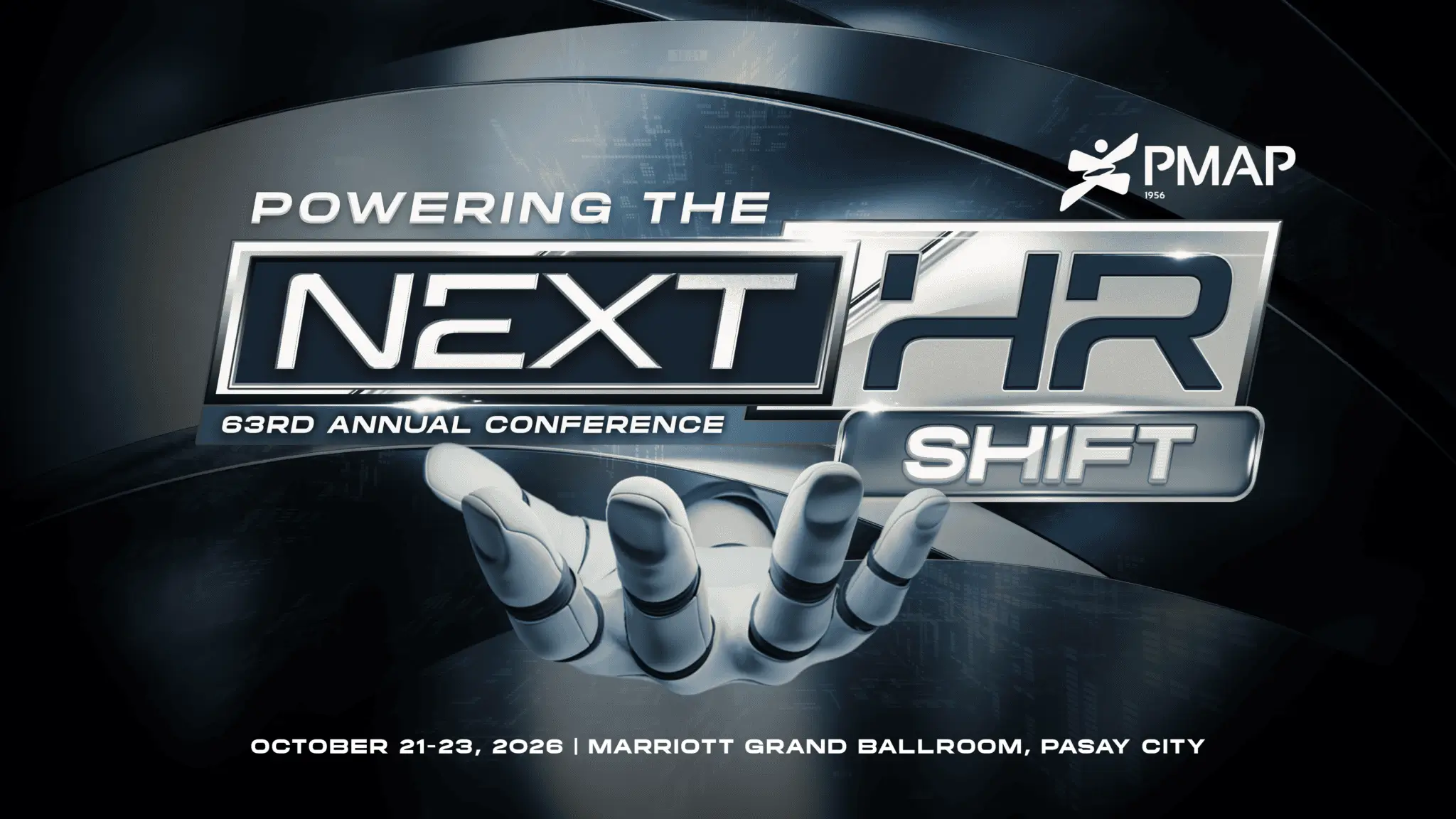
AI was everywhere at the 63rd PMAP Annual Conference. Yet the most important conversations were not about technology at all. Instead, they centered on people, leadership, and how work itself must change.
Held on October 21 to 23, 2026, at the Marriott Grand Ballroom in Pasay City, the conference carried the theme Powering the Next HR Shift. You can view the event details on the PMAP website: https://pmap.org.ph/annual-conference-2026/
On Day 1, four members of the John Clements team spread out across the plenary sessions and breakout labs. Each brought back a different lens. Together, their notes tell one clear story: the future of work belongs to organizations that redesign work, rethink talent, and keep people at the center.
As Roger put it, “Three speakers. Three different perspectives. One shared message: the world of work is changing, and we need to be ready.”
Here is what our team learned.
Redesign Before You Automate
Enrique Rubio, Founder of Hacking HR, opened the conference with a clear challenge to HR leaders: rethink how organizations are built.
His strongest message was that AI should not simply sit on top of existing processes. After all, technology will not fix what is already broken. Organizations must first define the outcome they want, map the work, and decide what people should do and what AI can handle. Only then should they redesign roles and teams. In his words, “redesign before you automate.”
Rubio also questioned the meaning of a “job.” Traditionally, organizations have been built around positions. In an AI-enabled workplace, however, the starting point shifts to the work itself and the outcome it should deliver. From there, leaders decide who, or what, is best placed to do it.
Consequently, HR gains a bigger role. Rubio envisions HR as the trailblazer that leads organizations into the future of work, rather than a function that supports the business from the sidelines.
For Roger, this hit close to home. “We cannot keep looking for people based on yesterday’s job descriptions when the work itself is changing,” he wrote.
The Hard Talent Calls: What Work Should Humans Do?
Rubio’s call to redesign work found a practical follow-through in the afternoon. In “Productivity, Performance & the Hard Talent Calls in an Age of Disruption,” Bhavana Chauhan, APAC Hi-Tech Industry Leader for Talent Solutions at Aon, flipped a common question. Instead of asking whether AI will replace people, she urged HR to ask what work we actually want humans to do.
For Dea, that question reframed the role of HR itself. “HR’s role is not simply to manage people, but to create value,” she noted.
Rethinking Entry-Level Work
Chauhan pointed to IBM as an example. In 2023, the company slowed back-office hiring, with roughly 7,800 roles seen as replaceable by AI over five years. Then in 2026, IBM announced plans to triple its US entry-level hiring, with those roles redesigned around customer interaction, judgment, and oversight of AI output. Read more about IBM’s shift here: https://www.computing.co.uk/news/2026/ibm-to-triple-entry-level-hiring
Her point was simple: leading companies are not just cutting work. They are redesigning it.
She also shared a bold hypothesis. The new entry-level employee, she suggested, may become a manager, not of people, but of a fleet of AI agents. The agents handle transactional work, while the human oversees their output. Although this remains a hypothesis, Dea observed that “watching what IBM is doing with junior roles, I can see the direction.”
Breaking Jobs into Tasks
The session’s workshop put these ideas into practice. Participants were grouped by table and asked to redesign an organization for a world where humans and AI work side by side.
One exercise stood out: take any job, break it into tasks, and classify each one as AI-led, human-led, or hybrid. In recruitment, this means reviewing sourcing, screening, scheduling, and client conversations, then weighing the time each takes against the value it creates. Still, Dea offered a sensible caution: “Automation may free up capacity, but its impact on roles and headcount will vary, so the value needs to be measured before we bet on it.”
The Numbers Behind the Shift
The stakes are real. According to the World Economic Forum’s Future of Jobs Report 2025, global trends are expected to create 170 million new jobs and displace 92 million by 2030. That is a net gain of 78 million jobs, yet 22% of jobs will be disrupted, and 39% of workers’ core skills are expected to change. See the full findings here: https://www.weforum.org/press/2025/01/future-of-jobs-report-2025-78-million-new-job-opportunities-by-2030-but-urgent-upskilling-needed-to-prepare-workforces/
These projections reflect several trends, not AI alone. Even so, as Dea put it, the skills transition “is fundamentally a talent problem. Which means it is, at least partly, our problem.”
Robina Gokongwei-Pe: Stay Teachable
While many sessions focused on AI, Robina Gokongwei-Pe brought the conversation back to fundamentals. Speaking from the Business Leader’s Chair, she shared 10 lessons from decades in retail, drawn from the people she learned from and the mistakes she made along the way.
One lesson was candid: “I should have taken more accounting lessons.” Her point was not that every leader must become an accountant. Rather, leaders need to understand the numbers well enough to ask the right questions, and to hire people whose skills complement their own.
Another lesson balanced data with people. You learn half from spreadsheets and half from talking to the people doing the work. Numbers tell you what happened, but people on the ground can often explain why. As she observed, people are often more masipag, or hardworking, than what you see.
Above all, Roger took away the value of humility. “Leadership is not about knowing everything,” he wrote. “It is about continuing to learn, from people, experience, numbers, and even competitors.”
From AI Risk to National Opportunity
Next, Benedict Hernandez, Senior Advisor of the IT and Business Process Association of the Philippines (IBPAP), brought the discussion home. His talk, “The National Pivot: Risk to Opportunity for the AI-Empowered Filipino Talent Force,” drew on years of driving transformation as an operator, not just as a consultant.
His central message: AI is not only a threat to jobs. It is also a chance to rethink the work Filipino talent can take on.
The Philippine IT-BPM industry already employs close to 2 million professionals, many with years of experience serving the world’s largest companies. That domain knowledge is a real asset. Learn more about the industry’s growth here: https://www.philstar.com/business/2026/01/01/2498004/it-bpm-sector-track-hit-40-billion-revenue-goal
Hernandez also noted that enterprise AI adoption remains slow and difficult. As a result, companies and countries still have time to prepare, and a chance to lead rather than follow. Like Rubio, he stressed that transformation should start with the process and the business outcome, not with AI upskilling alone.
He then raised a stronger possibility. If the Philippines makes this transition well, could it become a global AI services powerhouse? For Roger, that question changed the conversation entirely. It shifts the focus “from counting the jobs AI might replace to considering the opportunities we could create.”
Seeing People Beyond Their Labels
If the plenary sessions focused on redesigning work, the afternoon breakouts turned to the people doing it. In “Reassessing the Organization, Its People & Capabilities for What’s Next,” KC Costales found a timely reminder: preparing for the future is not only about new technology or better plans. It is also about giving people room to learn and grow.
Move Away from Fixed Labels
One key takeaway was the need to let go of fixed labels of potential. It is easy to judge someone by their current role, a single assessment, or past experience. However, someone who is not ready today may become ready with the right experience, guidance, and encouragement.
KC summed it up well: “We should recognize where people are now without limiting who they could become.”
Make Growth an Ongoing Conversation
The session also called for a shift from annual-only talent reviews to regular conversations about skills and readiness. KC suggested a few simple questions leaders can ask:
- What have you learned recently?
- What would you like to improve?
- What opportunity would help you grow?
- What support do you need?
Keep Humans Accountable
Finally, the session drew a firm line on AI. While AI can support learning and development, leaders must remain accountable for decisions about people. As KC wrote, “Technology can assist us, but it should not replace the care and judgment needed when making decisions about people.”
Beyond the Career Ladder
KC’s point that growth need not follow one straight path came to life in UNConference Lab 1: Redefining Career Progression in a World of Non-Linear Growth. Held in partnership with Aon, the session was facilitated by Rahul Chawla, Partner and Managing Director for Talent Solutions, and Sara Tiew, Regional Talent Advisory Director for Asia Pacific.
Mitch noted how the lab “moved beyond traditional presentations, encouraging meaningful conversations, collaboration, and collective problem-solving.”
From Mystery Paths to Business Solutions
The session opened with the Mystery Path game, which featured famous personalities whose unusual careers proved that success rarely follows a straight line. Next, six groups discussed how their organizations handle career progression and named their biggest challenges.
The groups then tackled a case study on Converge, which explored how to retain talent while building digital and technical skills. In particular, they examined how unclear career paths and barriers to internal mobility can leave employee potential untapped. Finally, each group pitched its solutions in a Shark Tank round, judged by the top three scorers from the Mystery Path game.
Growth Beyond Promotion
The lab’s biggest lesson: career progression is a business strategy, not just an HR program. Growth can mean moving up to greater responsibility, across into new roles, or deeper into specialized expertise.
Making this work takes shared effort. Leaders must create opportunities, HR must build accessible career paths, and employees must take an active role in their own development. As Mitch wrote, “Organizations grow when they make room for their people to grow.”
The Common Thread: Keep Learning, Redesign Work, Prepare People
Across every session, our writers heard the same three-part challenge. First, we need to keep learning. Second, we need to rethink how work gets done. Third, we need to prepare people, not just for today’s jobs, but for the work that comes next.
What This Means for Recruitment
For John Clements, these lessons point in one direction. Recruitment can no longer be only about filling vacancies. Instead, it must help organizations solve workforce challenges and anticipate the talent they will need as they evolve. In practice, that means:
- Recruit for skills, not just job titles. Prioritize adaptability, critical thinking, and transferable skills.
- Anticipate emerging talent needs. Help organizations prepare for new roles and changing skill requirements.
- Value human capabilities. Judgment, creativity, and relationship-building remain essential, even as AI takes on more tasks.
- Support non-linear growth. Help clients build career paths that let people move up, across, or deeper.
As Dea put it, “The future of recruitment isn’t just about filling today’s vacancies. It’s about connecting businesses with the talent they need for tomorrow.”
Ultimately, AI may change the work. Yet how we respond will decide whether we see it as a risk or an opportunity. And as Roger reminds us, “perhaps the best place to start is to remain teachable.”
Build a Workforce Ready for What’s Next
The next HR shift is already here. Whether you need specialized talent, a scalable hiring process, or leaders ready for change, John Clements can help you build the team your business needs tomorrow.
Let’s talk about your talent needs. Contact John Clements today: https://johnclements.com/contact-us/

