
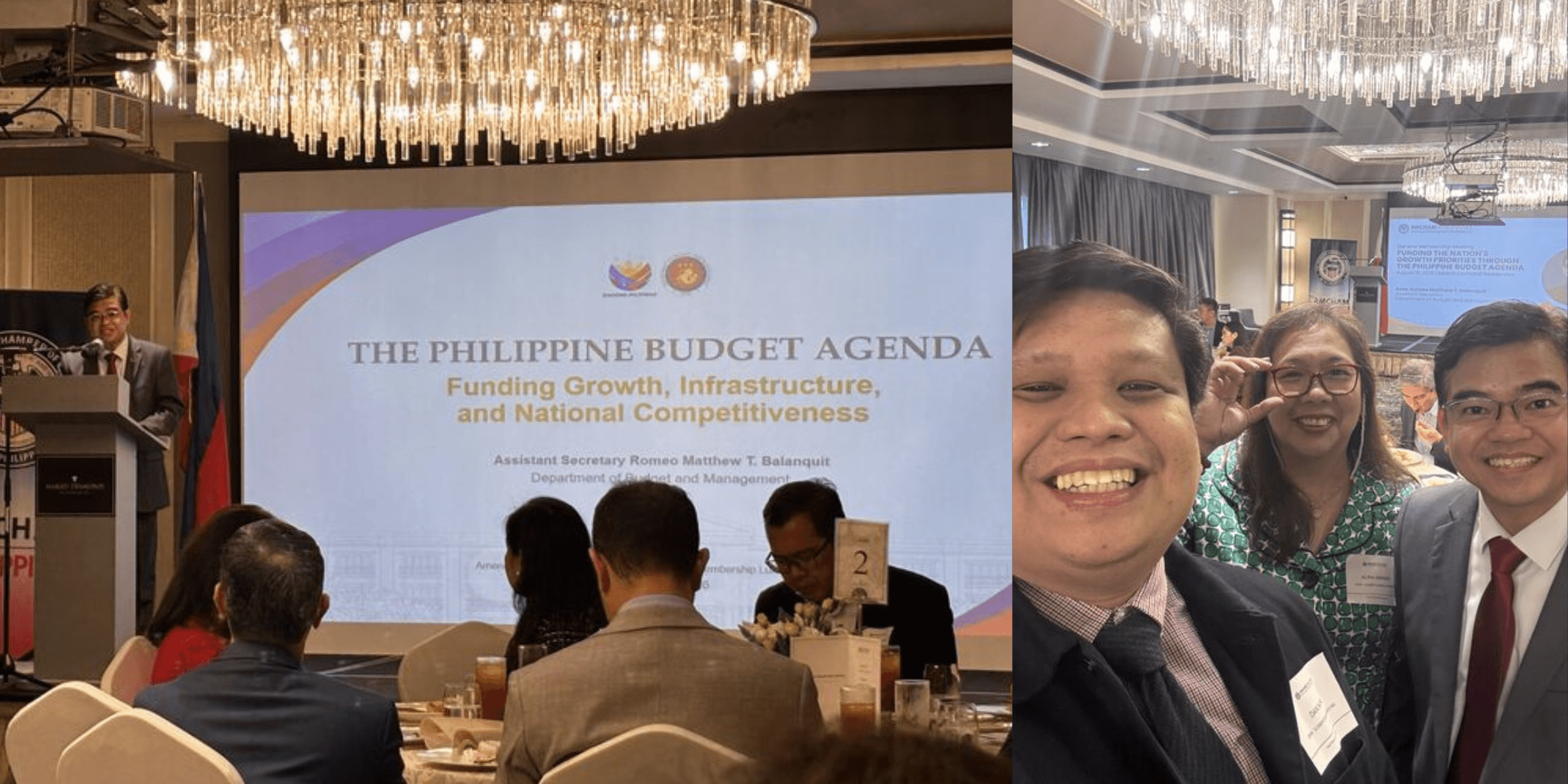
At the American Chamber of Commerce of the Philippines (AmCham Philippines) General Membership Meeting, business leaders gathered to discuss “Funding the Nation’s Growth Priorities Through the Philippine Budget Agenda.” Assistant Secretary Romeo Matthew T. Balanquit of the Department of Budget and Management (DBM), who leads the agency’s Budget Policy and Strategy Group, shared key insights into the proposed 2027 national budget and the government’s strategy for managing public resources in an increasingly complex economic environment.
The discussion offered an important perspective for companies and investors. The Philippine budget is more than a government spending plan. It signals national priorities and highlights where public investment could shape the business landscape in the years ahead.
Balancing Growth and Fiscal Discipline
The proposed ₱7.2 trillion National Expenditure Program represents approximately 21.7% of the country’s GDP. Government agencies submitted funding requests exceeding ₱11 trillion, making difficult budget decisions necessary.
Specifically, policymakers evaluated programs based on:
- Urgency
- Alignment with national priorities
- Implementation readiness
- Past performance
- Evidence-based outcomes
- Measurable impact
As a result, the focus is not simply on spending more money. Instead, the government aims to spend strategically and efficiently. For businesses, this approach matters because public spending directly affects infrastructure, workforce readiness, public services, and economic stability.
For more information on the budget process, visit:
https://www.officialgazette.gov.ph
Education and Workforce Development Take Center Stage
One of the largest investments within the Philippine budget is education. Approximately ₱1.3 trillion has been allocated across the Department of Education (DepEd), the Commission on Higher Education (CHED), the Technical Education and Skills Development Authority (TESDA), and state universities and colleges.
Why Education Matters to Business
A skilled workforce remains one of the Philippines’ strongest competitive advantages. Companies across industries require:
- Engineers
- Accountants
- Digital professionals
- Technicians
- Operations specialists
However, producing more graduates is only part of the solution. Equally important is ensuring that graduates possess the skills employers need. Consequently, workforce development should be viewed not only as an education priority but also as a long-term investment strategy.
Infrastructure and Digitalization Drive Productivity
Infrastructure and digital transformation remain major pillars of economic development.
The proposed ₱1.467 trillion allocation for the Build Better More program is 13.8% higher than the previous year. Yet the measure of success goes beyond spending levels. Businesses benefit most when infrastructure projects improve efficiency and reduce operational costs.
Key Expected Benefits
- Reduced travel and commute times
- Lower logistics costs
- Improved connectivity
- Increased business productivity
- Better access to regional markets
Furthermore, the government plans to allocate ₱53.1 billion for ICT and digitalization initiatives.
Digital transformation creates value when it:
- Simplifies government processes
- Connects systems across agencies
- Improves service delivery
- Reduces administrative burdens for businesses
In contrast, technology investments alone offer limited value if outdated processes remain unchanged.
Accountability and Flood Control Investment
The discussion also highlighted the importance of accountability in public spending. Investigations into flood-control projects caused delays in public construction activities. While oversight remains essential, businesses also benefit from consistent and predictable infrastructure development.
To strengthen accountability, policymakers have proposed several measures, including:
- An integrated flood-control master plan
- Satellite and drone monitoring
- Project geotagging
- Digital performance dashboards
- Enhanced controls against budget insertions
These initiatives can improve transparency while supporting long-term infrastructure goals.
Building Trust Through Stronger Governance
Beyond individual budget allocations, trust remains a critical factor in economic growth.
Businesses make investment decisions based on expectations about the future. They consider government policy, infrastructure planning, regulatory consistency, and institutional reliability.
Therefore, stronger public financial management can generate benefits that extend beyond government operations. Important governance initiatives include:
- Fiscal transparency
- Performance-based budgeting
- Digital monitoring systems
- Stronger accountability mechanisms
Collectively, these efforts can enhance business confidence and encourage long-term investment.
What the Philippine Budget Means for Business
As the Philippines continues its transition toward upper-middle-income status, the challenge is clear: convert economic growth into stronger national capabilities.
The Philippine budget points to several priorities that could support this objective:
- Better education and workforce readiness
- Modern infrastructure
- Accelerated digitalization
- Improved public services
- Increased investor confidence
For the private sector, these priorities provide insight into the country’s long-term direction.
The Philippine budget also demonstrates how government investment can create conditions that support business expansion, innovation, hiring, and productivity growth. While government alone cannot create prosperity, it can establish the foundations needed for sustainable economic development.
Ultimately, the success of the Philippine budget will not depend solely on the amount spent. Success will depend on whether these investments help build a more capable, connected, productive, and competitive Philippines.
What Business Leaders Should Watch Next
Businesses that understand government priorities are often better positioned to anticipate opportunities, manage risks, and align their growth strategies with emerging economic trends.
To learn how your organization can navigate workforce, business, and economic developments in the Philippines, contact the John Clements team:
https://www.johnclements.com/contact-us/
Source content optimized from the provided article on the 2027 national budget discussion and business implications. [Philippine…27 Article | Word]

