
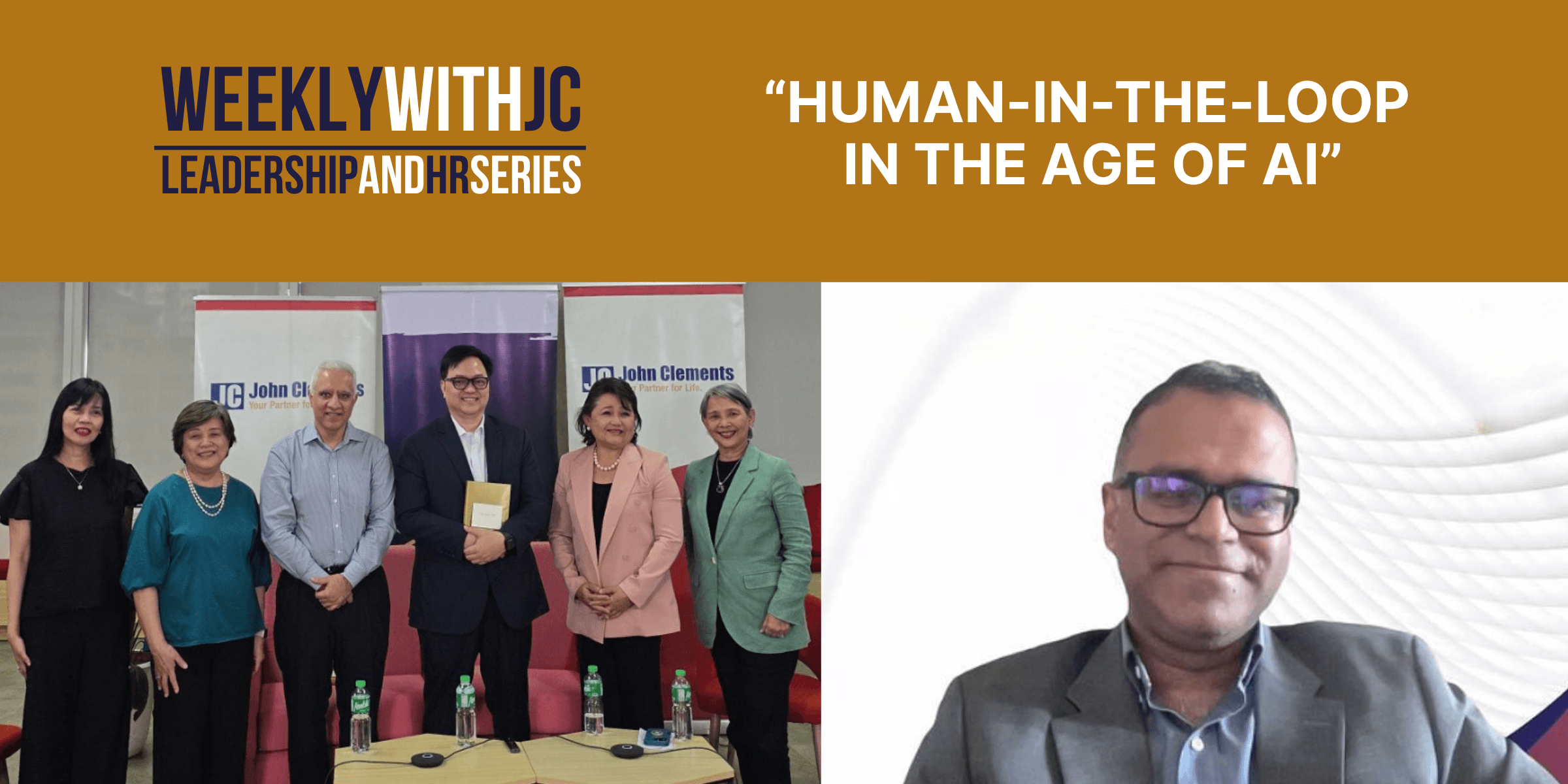
As we had our Leadership and HR Session, featuring distinguished panelists Vikas Singh, Co-founder & Chief Business Officer of Recruitment Smart Technologies; Adrian Tiozon, an experienced Human Resources Leader; and Rahul Dewan, Global Head of Operations Excellence, and moderated by Dr. Grace Alcid, Learning and Development Director of John Clements Consultants, the concept of Human-in-the-Loop (HITL) reminded us that while artificial intelligence is transforming the world at an unprecedented pace—reshaping how we work, learn, communicate, and make decisions—it still relies on human judgment, ethics, creativity, and accountability.
From personalized recommendations to autonomous systems, AI has become deeply woven into the fabric of everyday life. Yet amid this technological revolution, one question remains: should machines be left to decide on their own?
In this new era, keeping people involved is not optional. It is essential. Consequently, the future belongs to a strong partnership between humans and machines—not one or the other.
The Seed That Shaped the Future
Understanding the Human Sandwich Model
The session introduced the Human Sandwich Model. It shows how AI begins and ends with human input. Simply put, human-in-the-loop AI works like planting and nurturing a seed.
- Step 1: Human input
People provide prompts, context, and direction. This stage sets the foundation. - Step 2: AI processing
The system analyzes, computes, and generates outputs. It performs tasks like data synthesis, coding, and iteration. - Step 3: Human evaluation
Humans assess accuracy, add context, and ensure fairness.
This process highlights a key idea. AI does not work alone. Instead, human-in-the-loop AI ensures every output reflects human intent and responsibility.
Specifically, humans guide meaning, while machines deliver speed. Together, they create better outcomes.
Why Human Oversight Still Matters
AI can process massive data sets in seconds. That is powerful. Yet, it lacks empathy and ethical reasoning. In contrast, humans can interpret nuance and social impact.
Therefore, human-in-the-loop AI plays a critical role in:
- Preventing biased decisions
- Improving accuracy in complex tasks
- Ensuring accountability
- Strengthening trust in AI systems
According to global AI governance discussions, human oversight remains a key principle in responsible AI adoption (https://www.oecd.org/ai/). Similarly, ethical AI frameworks stress accountability and transparency (https://www.nist.gov/itl/ai-risk-management-framework).
Without human input, AI may produce errors or harmful outcomes. With guidance, it becomes a reliable partner.
The Philippine Workforce and AI
Turning Potential into Progress
The Philippines shows strong AI adoption signals. Reports suggest AI could boost the country’s GDP by up to ₱2.6 trillion with full integration. This estimate shows massive economic promise.
Data also reveals growing usage:
- 42.4% of Filipinos already use AI tools like ChatGPT
- Around 12.7 million users engage with AI systems
These insights align with digital adoption trends tracked by government initiatives (https://dict.gov.ph/) and industry policy frameworks (https://neda.gov.ph/).
However, a gap remains. Exposure does not always lead to optimization.
What’s Holding Progress Back?
Despite high awareness, organizations still struggle to maximize AI. The issue is not access. It is integration.
Many companies:
- Use AI for basic tasks only
- Lack structured workflows
- Fail to link AI to strategic goals
Consequently, the real opportunity lies in learning how to combine human expertise with AI capabilities.
From Tool to Transformation
Using AI is easy. Using it well is harder.
Organizations that succeed do one thing differently. They adopt human-in-the-loop AI as a strategic approach, not just a tool.
This shift delivers clear benefits:
- Better decision-making
- Faster operations with accuracy
- Stronger business outcomes
Furthermore, it builds systems that adapt and improve over time.
The advantage will not go to those who simply use AI. It will go to those who understand it deeply and apply it wisely.
AI continues to evolve. Yet, it does not replace human thinking. Instead, it enhances it.
The path forward is clear. Businesses must embrace collaboration between human insight and machine intelligence.
Ready to build smarter systems and future-ready teams?
Connect with us today: https://www.johnclements.com/contact-us/

