

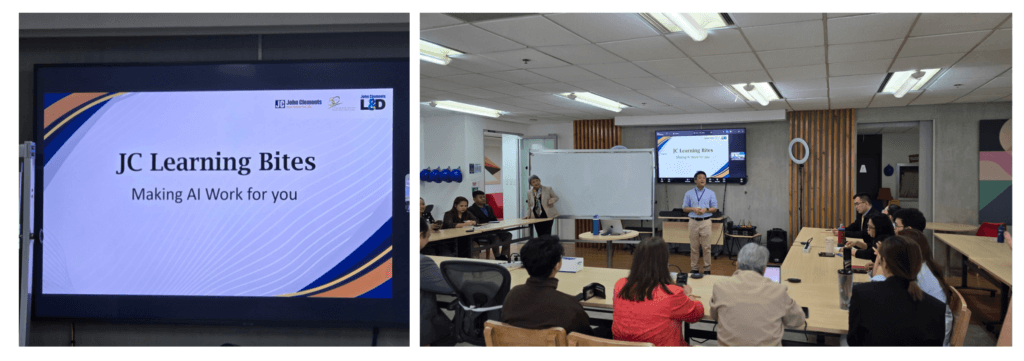
In this specific Learning Bites session, professionals and leaders gathered for one clear purpose: to understand how to make AI work for them — not against them. Moreover, led by Dr. Grace Alcid, the session moved beyond theory and hype and focused on what truly matters: practical application, responsible use, and real-world integration.
The central message was simple yet powerful: AI is not the future. It is the present.
Therefore, those who learn how to use it effectively will have a distinct advantage.
From Fear to Fluency
For many, AI once felt intimidating; even threatening. Would it replace jobs? Would automation make human skills irrelevant?
However, AI is not an autopilot that replaces professionals. It is a copilot that enhances them. It analyzes patterns, predicts possibilities, drafts content, summarizes information, and processes data efficiently. Yet it does not think, judge, or decide. That role still belongs to humans.
Dr. Grace emphasized a critical reminder: generative AI produces possible outputs, not guaranteed truth. Consequently, chances of hallucination remain. It can misinterpret context. It can reflect bias. That is why human supervision is not optional. It is essential.
Ultimately, the takeaway was clear: AI amplifies human capability; it does not replace human intelligence and creativity.
Understanding What AI Really Is
Participants explored the foundations of AI not in technical jargon, but in practical terms. At its core, AI functions through pattern recognition and prediction. It learns from data. Without that foundation, there is no AI.
Additionally, the group examined how AI has evolved over decades, from early neural network concepts in the 1940s to industrial automation in the 1960s, to IBM’s Deep Blue defeating a world chess champion, and finally to the widespread adoption of generative tools like ChatGPT in 2022. What feels like an overnight revolution has, in fact, been decades in the making.
Today, however, the difference is accessibility. You no longer need a computer science degree to leverage AI. You need curiosity, direction, and the willingness to experiment.
From Users to Creators
One of the strongest insights shared during the session was the shift in mindset required for the AI era.
In other words, it is no longer enough to casually use AI for quick answers. The competitive edge belongs to those who understand how to guide it.
Panelists discussed the importance of prompt engineering — giving AI clear, structured instructions to produce better results. In marketing, for example, AI can be instructed to write SEO-optimized articles with specific keyword density, limited passive sentences, and readability scores aligned with search engine standards. Therefore, the difference between a generic output and a strategic one lies in how you do a prompt.
This is where professionals evolve from AI users into AI creators.
Real-World Applications Across Departments
The session came alive as panelists shared how AI is integrated into their daily workflows.
In sales, AI supports pre-meeting research, helping professionals quickly gather company insights and refine intelligent talking points. As a result, what once required hours of browsing across multiple websites can now be accomplished in minutes. After meetings, AI tools transcribe discussions, summarize key insights, and extract action plans — improving both efficiency and confidence.
The Competitive Edge Belongs to Fast Learners
The AI revolution will not be led solely by programmers or engineers. In fact, many AI professionals today come from backgrounds in business, marketing, design, and operations. What sets them apart is not coding ability — it is adaptability.
The fastest learners will win.
The most curious will advance.
The most experimental will innovate.
This Learning Bites session reinforced that AI fluency is becoming a core professional skill, much like digital literacy once was. However, the difference now is speed. AI evolves rapidly, and continuous learning is no longer optional.
Key Learnings from the Panelists
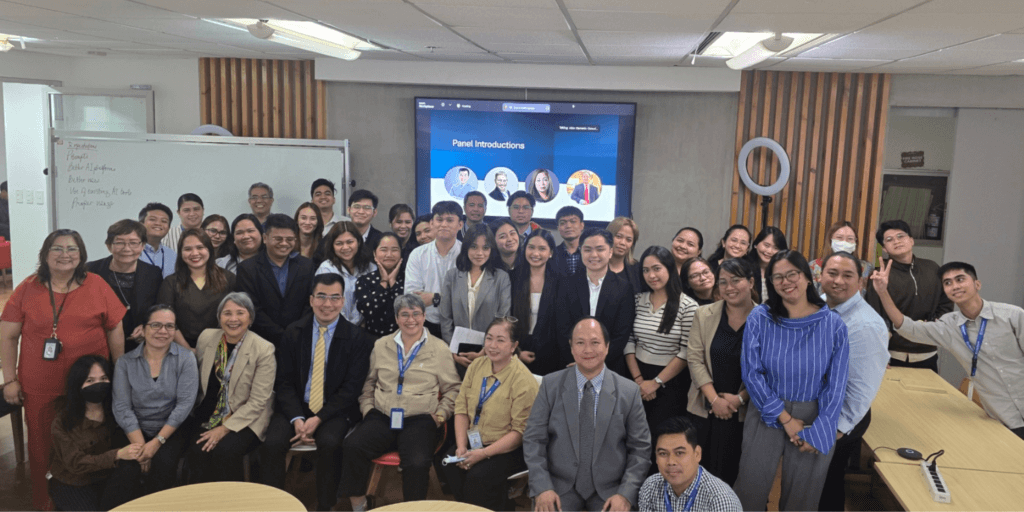
Beyond theory, the most valuable insights came from the lived experiences of the panelists — leaders who have integrated AI into their daily tasks.

1) Prompting Is a Strategic Skill, Not a Casual Task
Ms. MJ emphasized a powerful lesson for marketing professionals: AI is only as good as the instructions you give it.
Writing an article using AI is not about typing “write an article about marketing.” It requires structure and precision. She shared that when generating content, you must instruct the AI clearly — specify the focus keyword, control passive sentence usage (for example, limiting it to 10%), and align with readability metrics such as the Flesch Reading Ease Score, which search engines use to evaluate content quality.
In other words, AI does not automatically produce high-ranking content. Instead, you must teach it how to produce high-ranking content.
This transforms AI from a content generator into an SEO partner. The key learning: Prompt engineering is a professional advantage.
2) AI Requires a Shift in Thinking
Ms. KC Costales reflected on her early experience using Power BI as early as 2017–2018. The tool wasn’t necessarily difficult; it simply required a different mindset.
“If you think of it like Excel, it becomes difficult,” she implied. “You have to think differently.”
AI adoption is not about forcing yourself to use every tool available. It is about understanding your workflow and identifying where AI adds value. Not every task requires automation. Thus, maturity in AI usage means knowing when to insert it and when to step back.
She also highlighted an important truth: sometimes we are already using AI without realizing it. Many enterprise tools already contain AI features. Therefore, awareness is the first step to maximizing them.
The key learning: AI works best when it complements your natural workflow, not when it replaces it.
3) AI as a Confidence Multiplier in Sales
Sir Roger Santos shared how AI transformed his workflow during the pandemic. Long webinars, heavy research requirements, and presentation preparation once consumed hours.
By using transcription and summarization tools, he could extract insights from webinars efficiently. By leveraging AI for company research before client meetings, he prepared faster and smarter. AI even helped refine his talking points and structure intelligent questions tailored to industry and role. Consequently, the result?
More confidence in conversations.
More intelligent engagement.
Less time spent on manual preparation.
He also emphasized practicality — using free versions when possible, choosing different AI platforms depending on the task, and maximizing enterprise tools already available.
The key learning: AI increases both efficiency and professional confidence.
4) AI Configuration Requires Human Strategy
Sir Aris Metin brought a systems-level perspective. His involvement in configuring recruitment platforms like Sniper AI demonstrated that AI systems do not build themselves. They require committees, logic design, business input, and validation of outputs.
A background in computer science helped him think in terms of system development and output legitimacy, asking, “Is the output valid? Does it make sense?”
This highlighted a critical reminder: behind every powerful AI system is human judgment, structure, and intentional design.
The key learning: AI systems are only as strong as the human logic behind them.
5) AI and Data: The Marketing Advantage
Ms. MJ also discussed AI-powered marketing platforms such as HubSpot. Automation now allows teams to compile customer databases seamlessly through forms, segment audiences by executive roles, and streamline communication strategies.
As a result, instead of manually organizing spreadsheets, teams can focus on strategy and engagement.
The key learning: AI transforms raw data into actionable marketing intelligence.
The Overarching Insight
If AI were removed from daily workflows today, some panelists estimated their workload would increase to 10–14 hours per day. That single statement captures the transformation.
AI has moved from being an experimental feature to becoming an essential productivity partner. Nevertheless, throughout the discussion, one principle remained consistent.
AI is powerful.
AI is transformative.
But humans remain in control.
And that is the true competitive advantage.
Ready to Build Your AI Competitive Advantage?
Turn insight into action. Learning Bites 2026 made one thing clear: AI is no longer optional — it’s essential. The professionals who learn to guide it, refine it, and strategically apply it will lead their industries.
At John Clements, we help organizations strengthen their workforce through leadership development, corporate training, and future-ready talent solutions — so your teams don’t just use AI, they leverage it for real business impact.
Make AI work for you. Contact us and let’s start building your AI competitive advantage today.

