
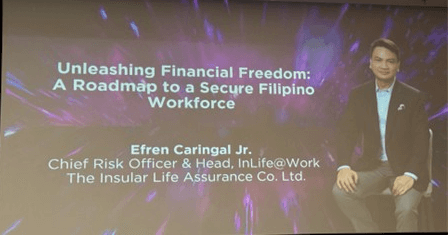
Are Filipino employees truly ready to retire when they want to, not when they have to? This was the central question tackled in Efren Caringal Jr., Chief Risk Officer and Head of Insular Life in his session “Unleashing Financial Freedom: A Roadmap to a Secure Filipino Workforce” at the PMAP conference in Cebu.
The session shed light on the country’s state of retirement readiness and the crucial role employers play in helping Filipinos achieve financial freedom. To make the discussion both engaging and educational, Caringal gamified the session through a “Jeopardy-style” format that encouraged active participation among the audience. The categories covered included The Retirement Reality Check, The Filipino Mindset on Money, Financial Literacy and Inclusion, and Rethinking the Role of HR in enabling financial wellness.
The Study: Are Filipinos Retirement-Ready?
Insular Life commissioned a research study involving 500 respondents to better understand the workforce’s retirement outlook, openness to retirement, perception of financial products, and overall financial readiness.
The findings were both revealing and sobering:
-
- Only 17% of respondents felt ready to retire given their current income.
-
- 30% expressed confidence about their financial preparedness — though most admitted they were not taking concrete steps to achieve it.
-
- Only 25% of Filipino adults could correctly answer basic financial literacy questions.
Filipinos tend to underestimate the true cost of retirement while overestimating their readiness, a gap driven by cultural norms such as utang na loob and the bahala na mindset, which delay financial action and reinforce dependency patterns, including the so-called “sandwich generation”, those who support both parents and children simultaneously.
The Filipino Mindset and the Role of Trust
One of the most striking findings was that 33% of respondents said they lack trust in financial institutions due to either bad experiences or limited understanding. This distrust prevents many from investing or seeking professional advice, keeping them in cycles of financial dependency.
This is where HR leaders can make a difference by bridging the gap between employees and credible financial institutions, ensuring that partnerships truly serve employees’ best interests.
Generational Perspectives on Retirement
Interestingly, younger Filipinos are more aspirational about early retirement.
-
- 22% of Gen Z respondents said they aim to retire between the ages of 46 and 50, compared to 14% of the general population.
However, these ambitions rarely align with financial reality. Many underestimate how much they’ll actually need.
- 22% of Gen Z respondents said they aim to retire between the ages of 46 and 50, compared to 14% of the general population.
When asked what a “comfortable” retirement income would be, most cited ₱25,000 to ₱50,000 per month far below what’s required when inflation and lifestyle changes are factored in. As Caringal emphasized, “retirement planning should not be based on current expenses, but on future realities.”
The Link Between Financial Wellness and Workplace Performance
Financial wellness is not just a personal concern; it’s an organizational issue with a measurable impact on productivity, retention, and engagement.
Research presented in the session revealed that financial anxiety causes “presenteeism”. Employees may be physically present at work but mentally preoccupied with money worries.
Here’s what the data shows:
-
- Financially cared for employees are 56% more productive.
-
- Financially stressed employees are 2x more likely to look for a new job.
-
- Only 56% of financially stressed employees feel they have a promising future in their current organization, versus 69% among those who are financially secure.
-
- 73% of financially stressed employees would be attracted to a new employer offering better financial wellness programs.
For HR, the return on investment (ROI) in financial wellness programs is significant:
-
- +17% productivity
-
- –28% absenteeism
-
- +24% employee satisfaction
Clearly, financial care has become the new engine of employee commitment.
Why Retirement Readiness Is an Employer Responsibility
Caringal emphasized that retirement security is built on three pillars of government pensions, private insurance or investments, and the workplace.
Of these, the workplace is the most stable and immediate touchpoint for financial empowerment. HR departments have a unique opportunity to:
-
- Provide access to financial literacy programs,
-
- Offer employer-supported retirement or savings plans, and
-
- Encourage long-term planning habits among employees.
When employees are financially prepared, organizations benefit from greater engagement, loyalty, and trust — creating a virtuous cycle of mutual security.
The Stages of Financial Wellness
Caringal outlined a progression that every individual can follow toward true financial freedom:
-
- Financial Dependence – relying on others for financial needs
- Financial Solvency – meeting obligations, but with little savings
- Financial Stability – managing debt, building emergency funds
- Financial Security – consistent savings and insurance protection
- Financial Independence – income from savings and investments covers expenses
- Financial Freedom – ability to make choices without financial constraint
- Financial Abundance – capacity to help others and leave a legacy
Each stage demands not just income growth but discipline, awareness, and action.
Key Takeaways
-
- Financial freedom starts with awareness. You can’t manage what you don’t understand — knowing where your money goes is the first step to controlling it.
-
- It’s not about how much you earn, but how wisely you manage it. Smart budgeting, saving, and investing build security faster than increasing income alone.
-
- Financial discipline equals long-term freedom. Consistency in saving and avoiding unnecessary debt gives you control over your future choices.
-
- Retirement readiness is part of financial freedom. True freedom means being able to stop working when you want to, not when you have to.
-
- Employers play a key role. By promoting financial literacy and offering sound retirement plans, organizations empower employees to live confidently now and in the future.
-
- Freedom is both mindset and habit. Shifting from “I’ll start later” to “I’ll start now” separates the financially free from the financially stuck.
The Call to Action
Unleashing financial freedom starts now and it starts with each of us. For individuals, it’s about awareness and consistency. For employers and HR leaders, it’s about enabling systems that build trust, confidence, and access to sound financial choices. When Filipinos can retire when they want to, not when they need to: that’s when we’ve truly achieved financial freedom.
Empower Financially Secure Workforces Today
Achieving financial freedom in the Philippines starts with action — and organizations play a key role in leading the way. At John Clements Consultants, we partner with employers to design people-focused strategies that enhance employee well-being, financial literacy, and long-term security.
Ready to help your workforce thrive financially? Contact us today to learn how John Clements can help you build a more empowered and future-ready organization.

