

The recently concluded International IT-BPM Summit brought together local and international leaders in the Information Technology–Business Process Management (IT-BPM) industry, setting the stage for an honest and forward-looking discussion on the sector’s trajectory. Showcasing key Philippine IT-BPM leadership insights, the summit highlighted the sector’s resilience, its role in shaping the future of global services, and its readiness to embrace artificial intelligence (AI) amid geopolitical and regulatory challenges.

Strong Performance and Roadmap Gains
In his President’s Report, Jack Madrid described the summit as both a celebration of past achievements and a call to action. Since the launch of Roadmap 2028, the sector has added 450,000 new jobs and generated $10.5 billion in additional revenues since 2022. Projections remain bullish: 80,000 new jobs and $2 billion in revenues are expected in 2025. By 2026, the industry is projected to reach $42 billion in revenues and nearly two million jobs.
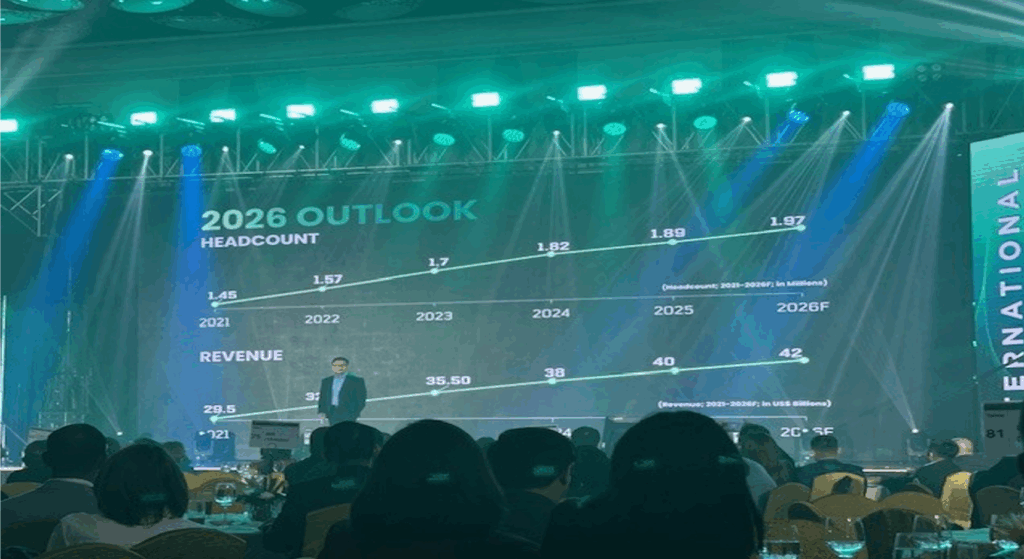
These figures reaffirm the Philippines’ position as a global leader in IT-BPM. At the same time, they underscore the scale of transformation needed to stay competitive. Notably, the rise of Global Capability Centers (GCCs) has been promising. These centers are evolving from traditional support hubs into strategic engines of innovation.

AI as Disruptor and Enabler
A recurring theme throughout the summit was AI’s dual role: both disruptor and enabler. The emergence of next-generation agents and advanced automation is reshaping workflows, client expectations, and job structures. Although fears of an “AI jobs apocalypse” surfaced, industry leaders rejected this narrative. Instead, they emphasized that AI would transform roles rather than eliminate them.

New opportunities are expected to emerge, requiring workers to cultivate curiosity, creativity, and emotional intelligence alongside technical skills. Nevertheless, the challenges are formidable. A sobering statistic shared during the sessions revealed that 95% of enterprise AI pilots fail. To address this, panelists stressed the need to shift from a tech-first to a process-first strategy—embedding AI into systems of execution rather than treating it as a standalone tool.
The call for a national AI strategy was resounding. Leaders advocated for coherent governance frameworks, responsible practices, and robust talent development.
Geopolitical and Regulatory Pressures
The IT-BPM sector does not operate in a vacuum. Geopolitical tensions, shifting trade dynamics, and regulatory uncertainties continue to influence the industry’s trajectory. Concerns were raised about the over-regulation of AI, inconsistent tax interpretations by local governments, and bottlenecks in agencies such as the Bureau of Internal Revenue and Customs.

Despite these challenges, the summit reaffirmed the Philippines’ enduring competitive advantages: a large, adaptive talent pool, strong government support, and a strategic position in global services. However, complacency was flagged as a looming threat. Leaders urged continuous innovation and agility to maintain momentum.
Talent and the Future Workforce
A consistent message across sessions was the urgent need to assess and upskill the workforce. As AI transforms traditional roles, new opportunities in domain expertise, design thinking, and responsible AI oversight are emerging. Companies like EY are already investing heavily in building an AI-native workforce. This demonstrates how organizations can lead transformation by aligning skills development with strategic goals.
The industry’s trajectory depends on nurturing future-ready talent capable of meeting the demands of an increasingly AI-driven global economy. Achieving this requires not only private sector investment but also deeper collaboration among government, academia, and industry players.
Responsible AI and Human Oversight
Several panels emphasized the importance of responsible AI practices. Systems must be continuously monitored for accuracy, fairness, and bias. Human oversight remains essential—especially in high-stakes industries such as healthcare and finance. Leaders noted that AI must be democratized so employees across all levels understand and trust its applications.
A Sector on the Rise
By the summit’s close, the message was clear: the IT-BPM industry is not in decline but in renaissance. With a $1.32 trillion global opportunity in BPM-AI, the sector is well-positioned to capture value—provided it can align policies, talent, and innovation with the realities of a fast-changing world.
The International IT-BPM Summit showcased both progress and urgency. The industry’s performance remains robust and its projections inspiring. Yet its challenges: AI adoption, geopolitical pressures, and governance gaps are real and pressing. What emerged was not a portrait of an industry in crisis, but of one standing at the crossroads of reinvention, ready to embrace transformation while keeping the human element at its core.
Future-proof Your Workforce with JC Tech
As the IT-BPM industry evolves toward AI-powered services and enterprise innovation, JC Tech helps you stay ahead. Build resilient teams, scale your GCC footprint, and unlock transformation with the right talent. Explore JC Tech.

